
 Integrated Polishing System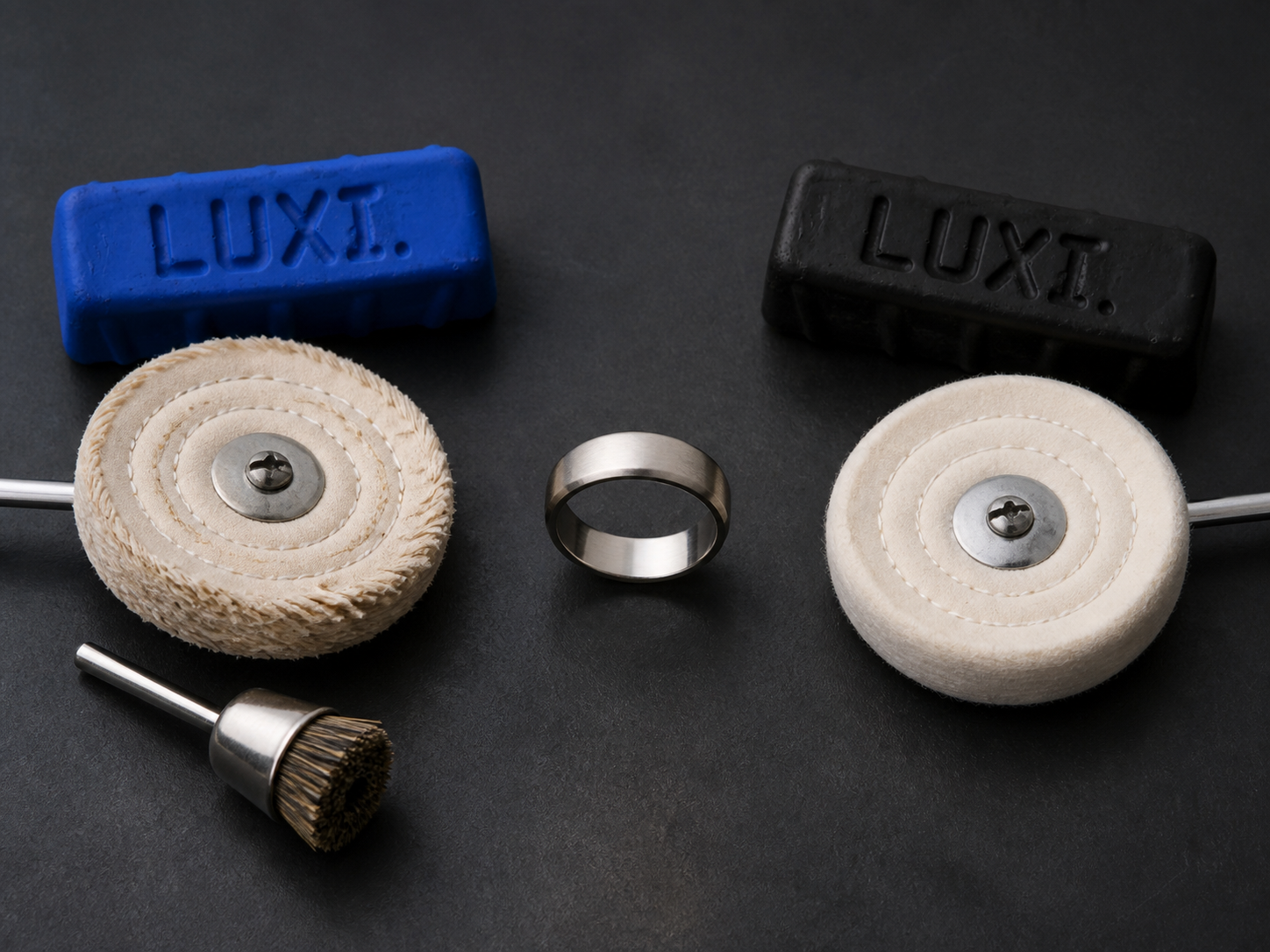
This workflow helps select one strong first-stage compound: LUXI Asian Blue or LUXI Black. It does not prescribe a mandatory two-compound sequence and does not treat LUXI Black as automatic “preparation” before another first-stage compound.
LUXI Asian Blue is the most aggressive compound in the LUXI range. LUXI Black is the second most aggressive and is selected when strong action is required but maximum LUXI Asian Blue activity is unnecessary. A transition between them is a special decision based on the actual trace, not a standard chain.
Entry condition
Do not use LUXI Asian Blue or LUXI Black directly after casting. Before polishing, complete:
- item geometry;
- required repair;
- removal of major protruding defects;
- even abrasive preparation.
For many tasks, P400 is a common minimum starting point. Preparation to P600 or finer is preferred according to material, item shape, contact area, and required result. Some material branches, including platinum, may require finer preparation according to the relevant product-specific or material-specific workflow.
Do not leave deep scratches, cracks, open cavities, geometry errors, or unfinished repair for an aggressive compound to correct.
When to choose LUXI Asian Blue
Choose LUXI Asian Blue when:
- the material is among the most difficult to polish;
- correctly selected LUXI Black with a suitable tool is not active enough;
- a large flat or open surface reduces the action of a milder compound;
- the most intensive first stage within the LUXI working range is required;
- local relief or a recess requires a small short stiff bristle brush.
Select the confirmed LUXI Asian Blue tools according to geometry and required contact:
- Split-lap for large flat surfaces;
- sisal for maximum intensive action;
- hard stitched cotton for strong but more controlled contact;
- suitable small stitched or treated stitched cotton tools for small items and local areas;
- a small short stiff bristle brush for recesses, inside corners, and complex relief.
No single tool is mandatory for every item.
When to choose LUXI Black
Choose LUXI Black when a strong first stage is required but maximum LUXI Asian Blue activity is unnecessary.
Select the confirmed LUXI Black tools according to material, contact area, and geometry:
- Split-lap or hard felt for large flat and open surfaces;
- sisal for the most aggressive LUXI Black action;
- hard stitched cotton for strong action with softer contact than sisal;
- a bristle brush for recesses and complex relief.
LUXI Black is not prescribed automatically after LUXI Asian Blue and is not a mandatory stage before LUXI Gray, LUXI Yellow, or another compound.
LUXI Asian Blue and LUXI Black are alternatives
Select one compound first. When correct preparation, a suitable tool, clean working body, minimal loading, and correct operating conditions do not allow LUXI Black to complete the first stage, LUXI Asian Blue may be considered.
When LUXI Asian Blue leaves a trace that is too coarse for the next operation, select the appropriate finer compound according to material and actual surface condition. This does not create a mandatory LUXI Asian Blue → LUXI Black transition.
Operating conditions
For a standard wheel approximately 150 mm in diameter, 2500–3000 rpm is the working starting range. Do not transfer this range automatically to a small wheel, brush, felt tool, or another diameter.
For another tool, consider:
- linear surface speed;
- contact area and stability;
- rpm drop under load;
- surface temperature;
- item geometry;
- actual material behaviour.
Apply the selected compound minimally to a clean tool. Do not create a thick layer of compound and removed metal between the working surface and the item.
Work in short passes, keep the item moving, control pressure and temperature, and inspect the surface regularly. If the tool becomes dark, greasy, clogged, or leaves a contaminated trace, clean it before continuing.
First-stage completion criterion
The first stage is complete only when, after compound and removed metal have been eliminated:
- no visible marks from the last abrasive remain;
- the surface is even;
- intended geometry is preserved;
- edges and relief are intact;
- no overheating or instability is present.
Visible lustre alone is not sufficient while scratches or preparation lines remain on the cleaned surface.
Selecting the next product
After LUXI Asian Blue or LUXI Black has completed the first stage, select a finer product according to material, the trace left by the first stage, and the required result.
Material-specific transitions may use LUXI Gray, LUXI Yellow, LUXI Blue, LUXI Pink, LUXI Orange, or another approved compound. This workflow does not establish one universal downstream sequence.
Before changing products, remove LUXI Asian Blue or LUXI Black and removed metal completely, allow the item to cool, and inspect it under directed light. Use a separate clean tool for the next compound.
Stop conditions
Stop if:
- noticeable overheating occurs;
- flatness, an edge, or relief is lost;
- the surface becomes wavy or increasingly hazy;
- the tool damages adjacent raised areas;
- pores, cracks, or cavities open or grow;
- the result is unstable after cleaning and cooling.
Structural defects that remain or grow after cleaning require a return to preparation, repair, or production-suitability assessment. This workflow does not prescribe rejection or remelting automatically.
Cleaning and coatings
Select the cleaning method for the whole item: material, construction, stones, inserts, joints, coating, and next operation. LUXI iClean, ultrasonic cleaning, heated solution, solvent, and steam are not prescribed automatically.
Do not mechanically process a thin decorative, protective, electroplated, or PVD coating that must be preserved. Identify an unknown coating first. A sufficiently thick and stable layer permits only a separate test-based assessment on a sample or non-critical area.