
 Integrated Polishing System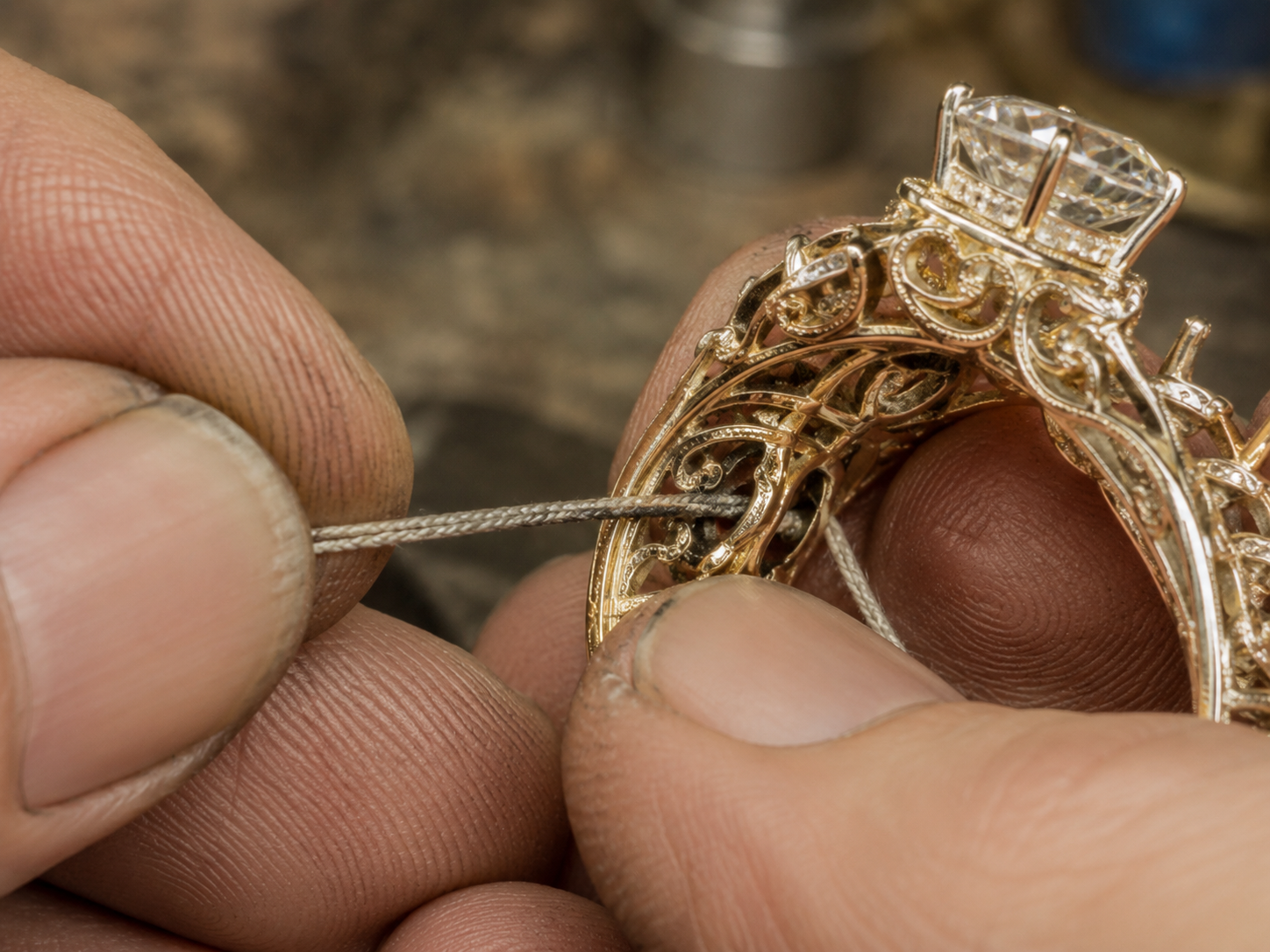
This workflow describes local low-temperature polishing with LUXI Purple and clean cotton thread or clean cotton cord in narrow passages and zones where a polishing wheel or bristle brush cannot create controlled access. Bristle brushes, felt, muslin, and cotton wheels belong to separate workflows.
When to use it
This route is intended for:
- narrow slots and gaps;
- spaces between elements;
- areas below settings;
- narrow channels accessible to thread or cord;
- through-openings and loops where the carrier can pass safely;
- other constrained zones that allow controlled back-and-forth motion without cutting edges or deforming details.
Select LUXI Purple by geometry, access, and the cotton-thread or cotton-cord contact rather than by one universal material name. The material, item construction, inserts, settings, joints, and surface condition must allow this mechanical polishing method.
Before local work, complete item geometry, required repair, abrasive preparation of the target zone, and the main first stage on accessible open surfaces.
Carrier selection
Use clean cotton thread or clean cotton cord whose diameter and structure pass through the working zone without wedging, cutting a groove, rounding edges, or smoothing surrounding details.
No universal thread or cord construction, diameter, twist, tension, stroke length, motion frequency, or processing time is prescribed. This workflow does not prescribe a synthetic, metal-wire, abrasive-coated, or unknown carrier.
Do not use this route with a bristle brush, felt tool, muslin wheel, stitched or unstitched cotton wheel, cotton wrap, or another dense polishing body.
Applying LUXI Purple
Apply enough compound to remain on the fibres and travel into the working zone, but do not overload the thread or cord.
Excess compound fills the zone, smears, reduces direct fibre contact, and makes cleaning more difficult. Too little compound falls away or fails to reach the working surface.
When the carrier is contaminated with old compound or removed material, polished smooth, frayed, damaged, or no longer structurally stable, reposition the working section or replace the carrier.
Working motion
Establish light controlled tension and use short repeatable back-and-forth strokes. Keep the carrier moving through the working zone. Do not create concentrated sawing action on one edge and do not increase tension automatically.
Between sets of strokes, clean the zone, release tension, allow the surface to cool, and inspect it under directed light and magnification.
Two conditional roles
When visible marks from the last abrasive remain and another tool cannot gain access, LUXI Purple may perform a local first stage. That stage is complete only when the marks are fully removed while edges, gap width, and fine details remain intact.
When the first stage is already complete, LUXI Purple may perform a local finish. After cleaning, the surface must be even, have the required lustre, and contain no matte areas, carrier grooves, or smeared compound.
Both roles depend on the entry condition of the specific zone and are not universal roles of LUXI Purple for every task.
If the result is insufficient
First clean the zone and confirm that preparation is complete. Then check, one variable at a time:
- whether the carrier reaches the working surface;
- whether its diameter and structure match the geometry;
- fibre cleanliness and condition;
- actual tension;
- stroke length and direction;
- the amount of LUXI Purple and compound retention;
- contact duration;
- temperature;
- completeness of cleaning and inspection.
Do not automatically add more compound, increase tension, or accelerate the motion before identifying the cause.
Use the separate LUXI Purple bristle-brush route for relief and recesses accessible to a brush. Use the separate LUXI Green route for small cotton and felt tools. LUXI Asian Blue is not prescribed on thread or cord and is not an automatic escalation when LUXI Purple appears slow.
Stop conditions
Stop if:
- edges become rounded or a groove begins to form;
- the carrier wedges, cuts, or deforms details;
- tension becomes unstable;
- the thread or cord frays, breaks, or becomes loaded with removed material;
- the surface becomes noticeably hot;
- compound smears or fills the zone;
- haze remains or increases after cleaning;
- cracks, cavities, or pores open or grow;
- the result remains unstable after cooling and cleaning.
These conditions require correction of the cause, a return to preparation or repair, or production-suitability assessment rather than an automatic increase in tension, compound, or contact time.
Cleaning and coatings
After polishing, remove LUXI Purple, removed material, and loose carrier fibres completely, then dry, cool, and inspect the zone under directed light and magnification.
Select the cleaning method for the whole item: material, construction, inserts, joints, coating, and next operation. LUXI iClean, ultrasonic cleaning, heated solution, solvent, and steam are not prescribed automatically.
Do not mechanically polish a thin decorative, protective, electroplated, or PVD coating that must be preserved. Identify an unknown coating first.