
 Integrated Polishing System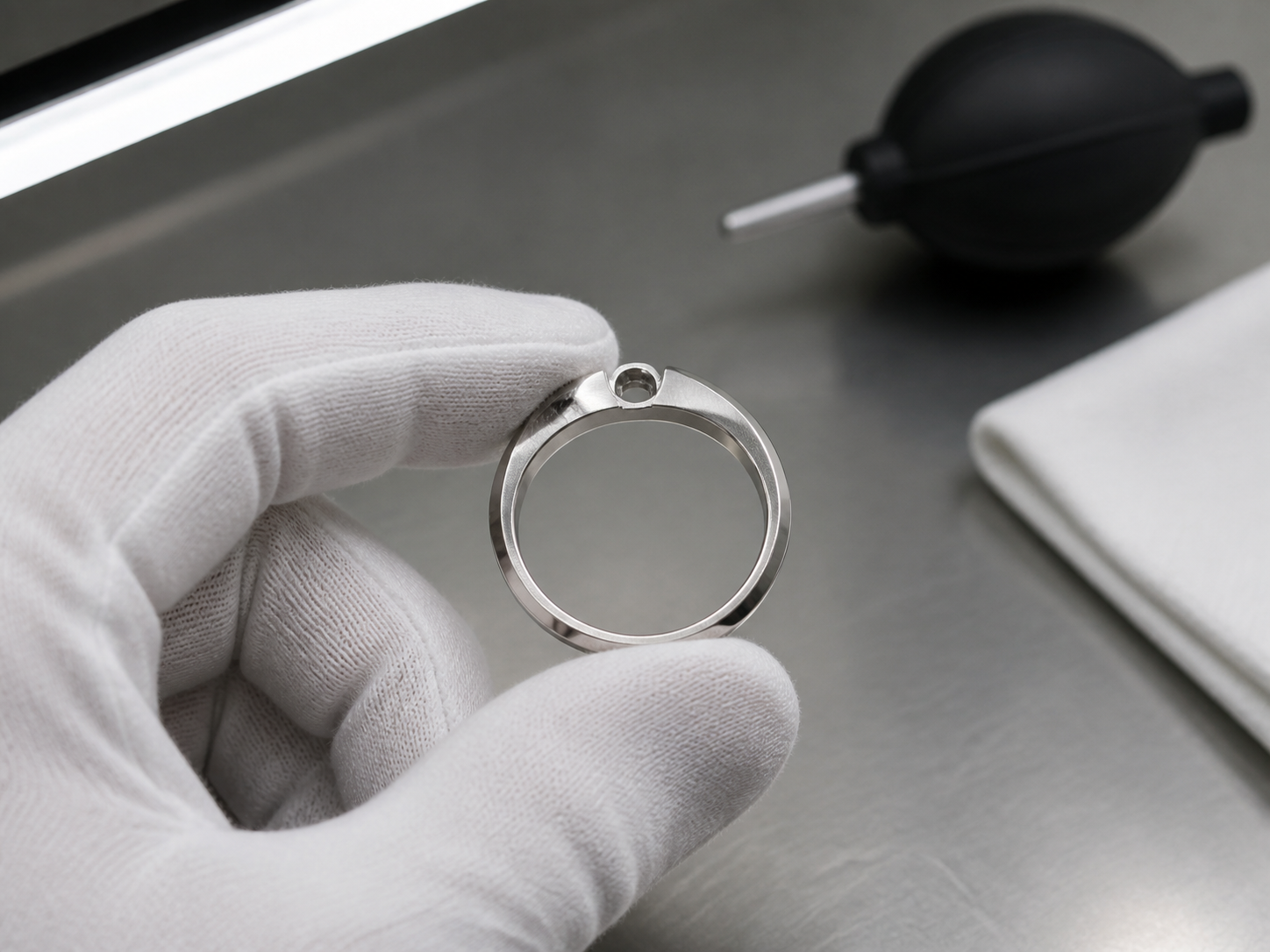
This workflow describes a clean finish on an open metal surface before future electroplating, PVD, or another operation sensitive to polishing-compound residue. It is not a recommendation to polish an existing thin coating.
Entry condition
Before finishing, complete:
- the item geometry and required repair;
- abrasive preparation;
- the appropriate first polishing stage;
- full removal of visible marks from the last abrasive;
- removal of first-stage compound residue and removed metal.
A finishing compound must not be used to correct deep scratches, unfinished shape, open cavities, large pores, or an incomplete first stage.
Choose one finishing product
LUXI Super Fine White, LUXI Red, and LUXI Orange are independent choices. They do not form a mandatory sequence.
- LUXI Super Fine White is the standard finish for a high, even lustre when the required surface quality is achieved after cleaning before the next operation.
- LUXI Red is selected when black-trace inspection of micropores and small irregularities is useful. The trace is a signal for cleaning and re-inspection, not proof of a defect.
- LUXI Orange is selected for an exceptionally high, even lustre, stricter final inspection, and preparation of open metal before operations sensitive to compound residue.
Do not add another finishing product automatically. Select one according to the material, the condition of the already formed surface, the required result, and the next production operation.
Separate clean working bodies
Use a separate clean tool for each product:
- LUXI Super Fine White — a clean unstitched muslin or flannel wheel;
- LUXI Red — a clean soft unstitched cotton wheel or a clean unstitched Luxol wheel; felt is excluded;
- LUXI Orange — a clean unstitched muslin or flannel wheel.
The exact Luxol fabric family is not established and must not be invented. Coarser compound residue must not be transferred to a finishing wheel.
Working conditions
For a wheel approximately 150 mm in diameter, use 2500–3000 rpm as the working starting range. For another diameter, select the operating conditions according to linear surface speed, contact area and stability, temperature, and material behaviour.
Apply the compound minimally. Work in short, smooth passes, keep the item moving, use light controlled pressure, and check the surface and temperature regularly. Excess compound, increased pressure, and prolonged continuous contact must not replace correct preparation or tool selection.
Cleaning before final assessment
After finishing, remove completely:
- compound residue;
- removed metal;
- greasy film;
- wheel contamination;
- residue in micropores, relief, settings, recesses, inside corners, and spaces between elements.
Select the cleaning method for the whole item: material, construction, stones, enamels, adhesive joints, coatings, hollow elements, and the next operation. Do not prescribe LUXI iClean, ultrasonic cleaning, heated solution, solvent, or steam automatically.
After cleaning, dry the item completely and allow it to cool. Inspect the surface under directed light. Accept the clean finish when the lustre and reflection remain even, no dull areas or marks from the previous stage are visible, and edges, relief, and geometry remain intact.
If cleaning reveals scratches, haze, pores, cracks, depressions, or unstable lustre, return the item to the appropriate preparation, repair, or production-suitability decision. Additional finishing compound is not an automatic solution.
Existing-coating boundary
Future electroplating or PVD on open metal and polishing an existing coating are different tasks.
- Do not mechanically polish a thin decorative, protective, electroplated, or PVD coating that must be preserved.
- Identify an unknown coating first.
- A sufficiently thick and stable metal, lacquer, or polymer layer permits only a separate test-based assessment on a sample or non-critical area.
- A successful general test does not create an automatic recommendation for a particular compound.
Pass the item to the next operation only after complete cleaning, drying, cooling, and final inspection.