 Integrated Polishing System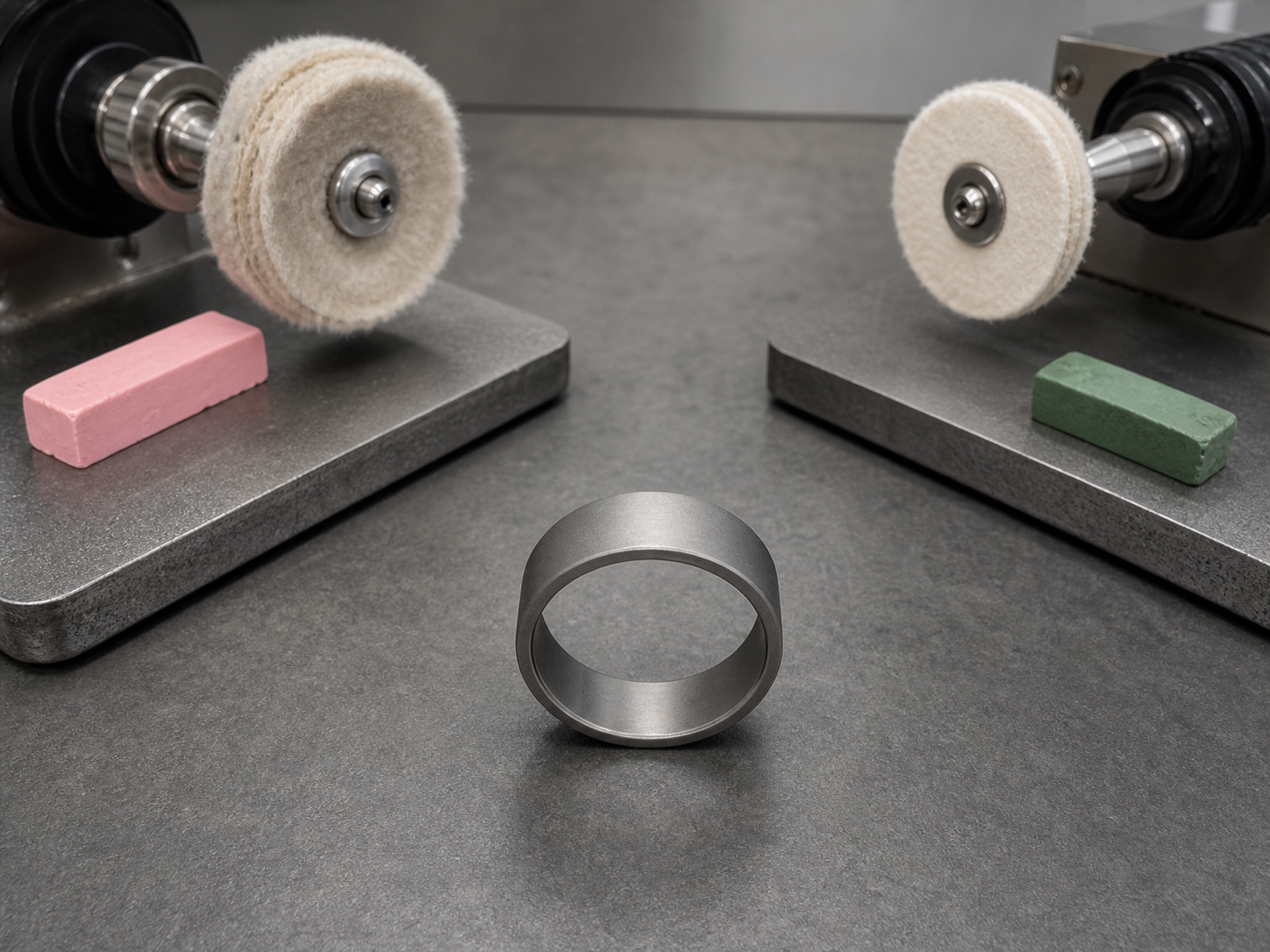
This workflow describes two alternative finishing routes for titanium after correct preparation and a fully completed LUXI Gray first stage. Select the route according to the particular titanium grade and its behaviour during a test polish.
LUXI Pink and LUXI Green are alternatives in this task, not consecutive stages. LUXI Green is not used automatically before LUXI Pink, and LUXI Pink is not a mandatory additional finish after LUXI Green.
Before selecting the finish
Before using this workflow, complete:
- item geometry;
- required repair;
- even abrasive preparation;
- the LUXI Gray first stage or another separately approved first stage appropriate to the particular titanium grade.
No universal abrasive grade or single universal first stage is established for every titanium grade. When LUXI Gray is used, it must fully remove the visible marks from the last abrasive, leave an even surface, and preserve shape, edges, and relief.
Select the LUXI Gray working tool from its product-specific card. No single cotton-fabric family is established for LUXI Gray and none should be inserted automatically.
Before selecting the finishing branch, remove LUXI Gray and removed material completely, clean the surface, allow the item to cool, and inspect it under directed light.
Test the particular titanium grade
Make a short test on a matching sample or on a non-critical area when the risk is acceptable.
Assess:
- how quickly lustre develops;
- surface temperature;
- the appearance of waviness or orange peel;
- preservation of edges and geometry;
- stability after cooling and cleaning.
Change one variable at a time and do not compensate for instability with excess compound, increased pressure, or prolonged continuous contact.
Route 1 — standard LUXI Pink finish
Choose LUXI Pink when the test shows that the surface remains stable at standard intensity without overheating, waviness, or orange peel.
Use LUXI Pink on a separate clean white unstitched Calico wheel. Muslin, flannel, felt, and stitched cotton wheels are not the primary LUXI Pink tools.
For a wheel approximately 150 mm in diameter, use 2500–3000 rpm as the working starting range. Do not transfer this range automatically to another diameter; consider linear surface speed, contact area and stability, rpm drop under load, temperature, and the behaviour of the particular alloy.
Apply LUXI Pink minimally. Work in short passes, keep the item moving, control pressure and temperature, and use cooling pauses where necessary.
The LUXI Pink finish is complete when the fully cleaned and cooled surface shows an even mirror reflection without dull zones, waviness, orange peel, or marks from the previous stage.
Route 2 — low-temperature LUXI Green finish
Choose LUXI Green instead of LUXI Pink when standard-intensity finishing causes overheating, waviness, orange peel, or another unstable surface response.
For the confirmed low-temperature branch, use a separate clean standard wheel at approximately 1000 rpm, very light pressure, short contacts, frequent inspection, and cooling pauses.
The exact fabric family of the standard LUXI Green wheel for this branch is not established in the confirmed data and must not be invented. Approximately 1000 rpm belongs only to this confirmed low-temperature branch and is not a universal LUXI Green speed.
Apply LUXI Green minimally. After every short contact, withdraw the item completely, check temperature and surface condition, and allow the item to cool.
The LUXI Green finish is complete when the cleaned and cooled surface remains even, stable, and uniformly bright without waviness, orange peel, smearing, or shape change.
LUXI Green and LUXI Pink do not form a sequence
Do not use LUXI Green as a mandatory stage before LUXI Pink. Do not add LUXI Pink after the low-temperature LUXI Green branch when LUXI Green has already produced the required stable result.
If LUXI Green does not produce the required result under the correct low-temperature conditions, return to preparation, first-stage completion, tool selection, and the behaviour of the particular titanium grade. Do not move automatically to LUXI Pink while thermal instability remains.
Shared operating rules
Use separate clean tools for LUXI Gray, LUXI Pink, and LUXI Green. Before changing products, remove the preceding compound and removed material completely.
Work in short passes, keep the item moving, and control pressure, temperature, and wheel condition. Excess compound and increased pressure do not replace correct preparation and branch selection.
Acceptance criterion
Accept the result only on a fully cleaned, dry, and cool surface under directed light. Confirm:
- the required even lustre;
- stable reflection;
- no waviness or orange peel;
- preserved edges, relief, and geometry;
- no compound or removed material in recesses;
- stability after cleaning and cooling.
Stop conditions
Stop if the process produces:
- noticeable overheating;
- waviness or orange peel;
- edge loss or relief smoothing;
- increasing haze;
- smearing or surface instability;
- opened or growing pores, cracks, or cavities;
- an unstable result after cleaning and cooling.
These conditions require a return to preparation, repair, or production-suitability assessment rather than an automatic increase in compound, pressure, or contact duration.
Cleaning and coatings
Select the cleaning method for the whole item: material, construction, inserts, joints, coating, and next operation. LUXI iClean, ultrasonic cleaning, heated solution, solvent, and steam are not prescribed automatically.
Do not mechanically polish a thin decorative, protective, electroplated, or PVD coating that must be preserved. Identify an unknown coating first.