 Integrated Polishing System
Hard second-group materials aggressive preparation
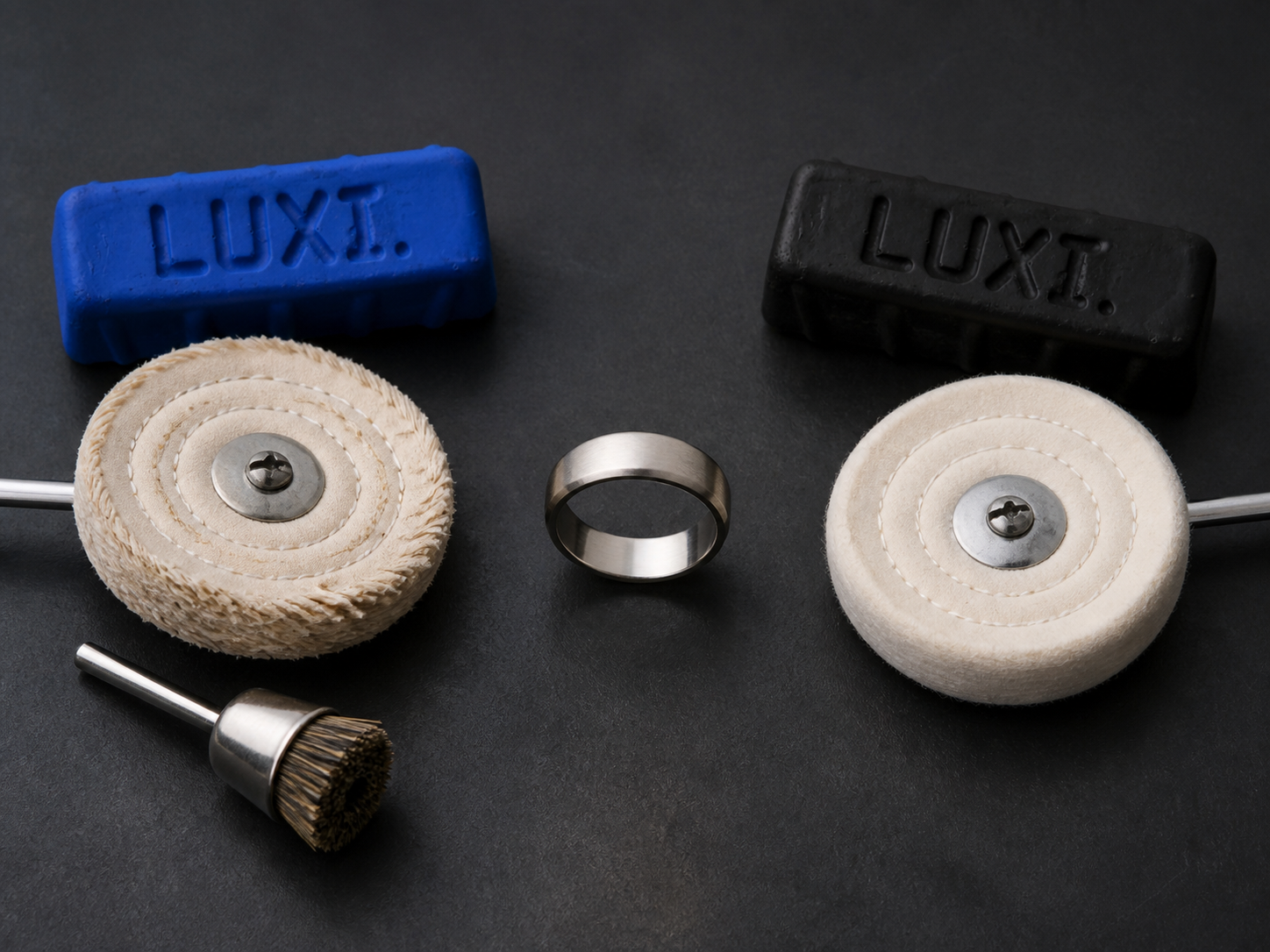
For titanium, stainless steel and cobalt-chrome, sanding may need to be followed by an aggressive preparation step before the first normal polishing stage. The purpose is to remove the deepest sanding marks, turn the sanded surface into a smoother matte surface, activate the surface and increase defectiveness of the microcrystalline surface layer so the next polishing stage can redistribute the Beilby layer in a more controlled way.
This stage is not final polishing. It is a readiness step that prepares a difficult surface for controlled polishing.
Standard hard second-group route
For stainless steel and Co–Cr, select the branch according to preparation and actual surface condition. LUXI Black, LUXI Gray and LUXI Yellow do not form a mandatory sequence. Platinum, titanium and soft metals use separate workflows.
Use LUXI Gray as the first stage when its action is sufficient. Select its tool from the LUXI Gray product card; no universal fabric family is assigned. After complete removal of the entry marks, cleaning, cooling and inspection, move directly to LUXI Pink only if the surface is finish-ready.
Use LUXI Yellow only as an optional transition when the completed first stage needs a softer trace before finishing. Use a separate clean white stitched Calico wheel. LUXI Yellow must not compensate for an incomplete first stage.
Choose LUXI Black only when stronger first-stage action is needed. Select its tool from the LUXI Black product card; sisal is not mandatory for every item. After the completed LUXI Black stage, use optional LUXI Yellow only if needed before LUXI Pink. A separate LUXI Black → LUXI Gray transition is justified only when the necessary LUXI Black stage leaves a trace requiring LUXI Gray before finishing.
Stage 2 — final polishing: LUXI Pink + separate clean white unstitched Calico wheel.
For this hard second-group final stage, use a separate clean white unstitched Calico wheel, not muslin or flannel.