
 Integrated Polishing System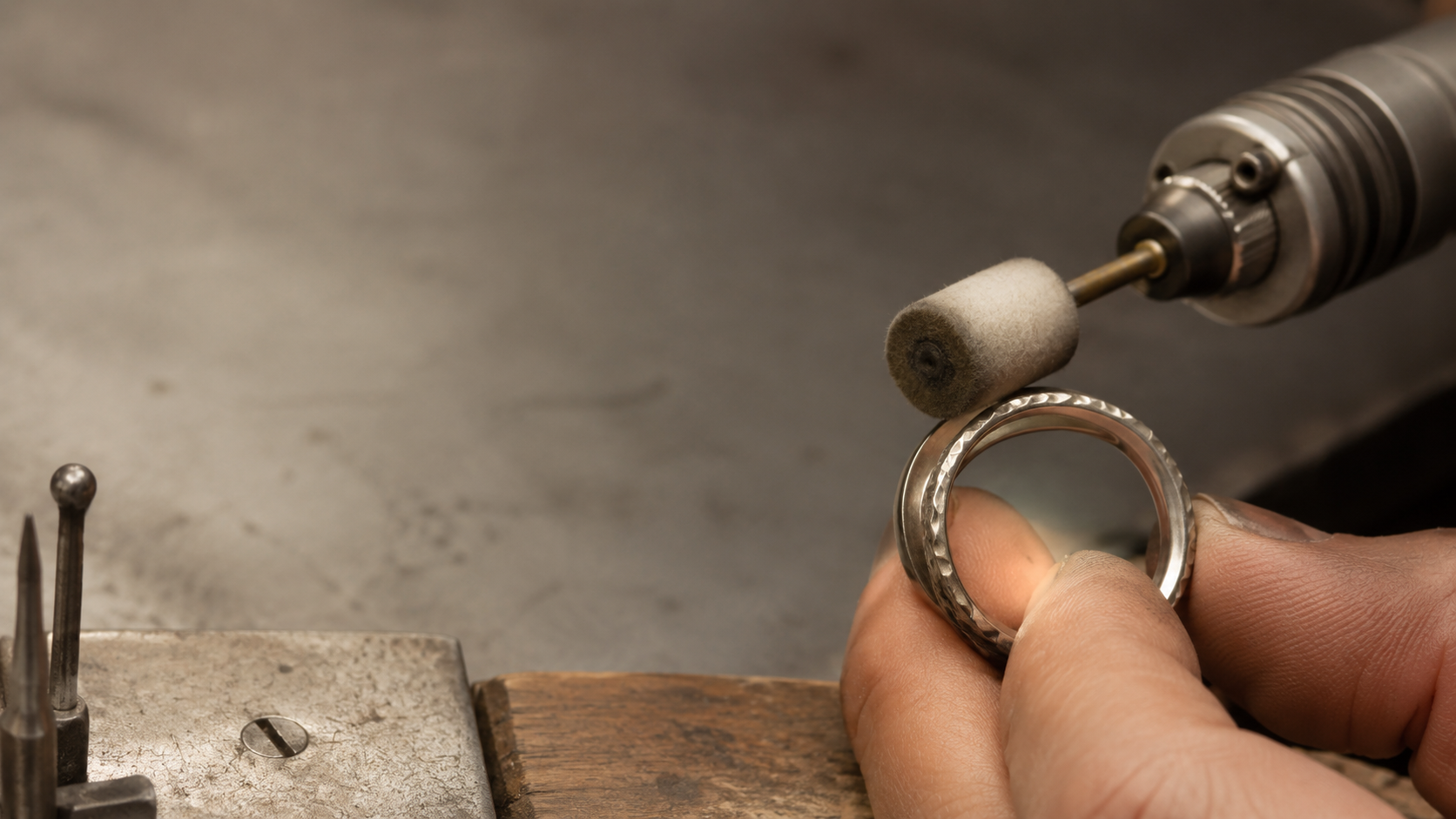
This work is not a reduced copy of ordinary polishing on a large wheel. A small tool has a small diameter, lower linear speed and a colder contact zone. It therefore requires a separate logic: more control, less overheating, short passes and a compound designed for that working situation.
When to use this workflow
This workflow applies to LUXI Green on small cotton and felt tools.
Typical cases:
- inside-ring polishing;
- cotton wrap on a polishing motor spindle;
- cotton wrap on a cone;
- cylindrical felt attachment;
- felt tool for inside polishing;
- small closed forms;
- local areas where a large wheel cannot enter;
- sensitive areas that require control and a gentle contact temperature.
The main goal is not maximum aggressiveness, but controlled local work in a colder contact zone.
Why LUXI Green is used
A cotton wrap or felt attachment usually works much more softly and colder than a standard wheel.
For example, a cotton wrap on a polishing motor spindle, about 15 mm in diameter, at 2500 rpm gives a linear speed of about 2.0 m/s. For comparison, a standard 152 mm wheel at the same 2500 rpm gives about 19.9 m/s.
This is why the normal large-wheel logic works poorly inside a ring or on a small attachment. LUXI Green helps maintain controlled surface action where the tool is small, contact is soft and the working temperature is lower.
What you need
- LUXI Green;
- a cotton wrap or felt attachment of a suitable diameter;
- a polishing motor, rotary handpiece or other tool with controlled rpm;
- a clean working surface of the tool;
- a correctly prepared item surface;
- gentle washing after polishing, if the item construction and materials allow it.
The tool must be clean. Old compound, removed metal or contamination may change the result and make the work unstable.
Surface preparation
Before using LUXI Green, the surface must be prepared.
LUXI Green must not correct rough sanding marks, deep scratches, shape errors or defects that should be removed before polishing.
If the inside of the ring or the local zone still has coarse preparation marks, return to surface preparation first. Polishing with a small tool must not become an attempt to remove excess metal with pressure and long work.
Applying compound
Apply LUXI Green minimally.
A short touch of the compound to the rotating cotton or felt tool is enough. The tool must receive compound, but must not be overloaded with it.
If there is too much compound, the tool starts smearing it, the surface may become cloudy, the work becomes dirty, compound clogs the inside of the ring or local recesses, and the result after washing may become worse.
In the LUXI system, excess compound does not replace the correct tool or the correct contact temperature.
Working inside a ring
For inside-ring polishing, the cotton wrap or felt attachment should be used in short, controlled passes.
Important points:
- do not stay too long in one spot;
- do not press too hard;
- do not overload the tool with compound;
- do not try to obtain the result through long friction;
- make sure the tool runs steadily and does not hit the surface;
- check the result frequently.
Inside a ring, it is easy to overheat a small area or create an uneven mark. Work calmly, briefly and with intermediate checks.
Working with a felt attachment
A felt attachment gives local contact and good control, but because of its small diameter it does not work as actively as a large wheel.
LUXI Green makes such work more stable.
Use a clean felt attachment, apply LUXI Green minimally, work with short passes, do not keep the tool in one point, do not increase pressure if the result is slow, and check that the felt is not becoming overloaded with compound and removed metal.
If the felt becomes dirty, greasy or dark, replace or clean it. Fresh compound on a contaminated tool does not solve the problem.
Working with a cotton wrap
A cotton wrap on a polishing motor spindle is often used for inside-ring polishing because it gives access to a closed form and gently adapts to the inner surface.
But a cotton wrap of small diameter works with low linear speed. For example, a wrap of about 15 mm at 2500 rpm gives about 2.0 m/s. It therefore needs a compound designed for a colder and softer contact zone.
LUXI Green is used for this task.
The wrap should be clean and even, its diameter should suit the inside shape of the ring, compound should be applied briefly and minimally, work should be done without strong pressure, passes should be short and repeatable, and the result should be checked frequently.
If the wrap starts smearing compound, leaving a dirty mark or working unevenly, stop and check the tool condition.
If the result is reached slowly
If LUXI Green reaches the result slowly, do not immediately add compound or increase pressure.
First check whether the tool is clean, whether the attachment is too soft or dirty, whether there is too little contact, whether the surface is correctly prepared, whether coarse marks remain from sanding, whether rpm drops under load and whether the tool geometry fits the zone.
If the task is not inside-ring polishing but relief, brush, cord, thread or recess work, the required workflow may be different: LUXI Purple for brushes, cord, thread, relief and recesses.
Where this workflow does not belong
This workflow is not intended for large planar surfaces, active first-stage polishing on a standard wheel or heavy production cases where higher linear speed and a more active wheel are needed.
LUXI Green on a small cotton or felt tool is a local, controlled workflow. It is not a universal replacement for other stages.
Washing after work
After inside-ring polishing or local work with a small tool, remove compound residue, removed metal and contamination.
Check especially the inner surface of the ring, areas near stones, recesses, seat edges and zones where the tool entered only partially.
For controlled washing after polishing, the LUXI system uses iClean where the material and construction of the item allow it.
The washing logic is explained in:
Typical mistakes
Judging the work only by rpm.
High rpm on a small tool does not mean the same linear speed as on a standard polishing wheel.
Adding compound instead of checking the tool.
If the cotton wrap or felt becomes contaminated, a new layer of LUXI Green will not fix the work.
Pressing harder when the result is slow.
Strong pressure can overheat a small zone, damage geometry and make the work dirty.
Using LUXI Green for brush and relief tasks.
If the compound must hold on bristles, thread or cord, the LUXI Purple logic is usually needed.
Trying to correct rough preparation with a small attachment.
The small tool should work on an already prepared surface. It must not replace sanding or the active first polishing stage.
Apply in practice
- Small tools and low-temperature polishing
- Wheel diameter, rpm and linear speed in the contact zone
- LUXI Purple for brushes, cord, thread, relief and recesses
- Washing after LUXI polishing
Mentioned products and tools
LUXI Green
Compound for controlled low-temperature work on cotton and felt small tools.
LUXI Purple
Compound for brushes, cord, thread, relief and recesses where retention on the carrier and active local action matter.
iClean
Controlled washing after polishing, if the material and construction of the item allow it.
Cotton wrap
Tool for inside-ring polishing and other local zones requiring soft access and control.
Felt attachment
Small tool for local polishing and inside work.
Main takeaway
LUXI Green is used not simply because the tool is smaller.
It is needed because cotton wraps, felt attachments and inside-ring polishing create a colder and softer contact zone than a standard polishing wheel.
Correct work is based on a clean small tool, minimal application of LUXI Green, short passes, pressure control and careful checking of the result.