

 Integrated Polishing System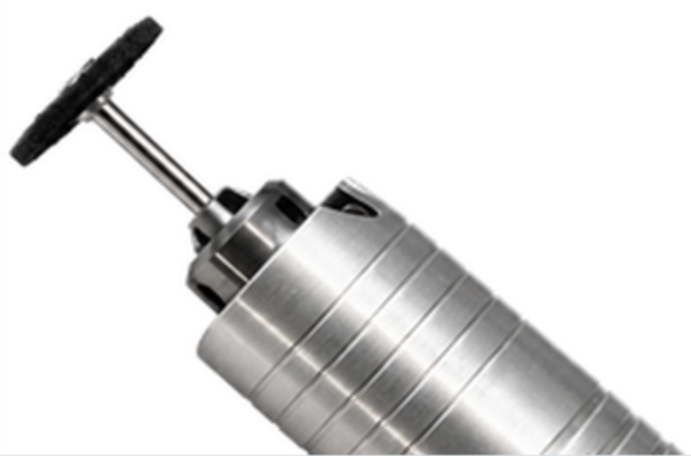
The main reason is linear speed in the contact zone. The larger the wheel diameter at the same rpm, the faster the working surface of the wheel moves, the more energy is delivered into the contact, the higher the temperature and the more active the first polishing stage can become.
In the LUXI system, it is therefore important to consider not only the compound and the wheel type, but also wheel diameter, actual rpm and how the tool behaves under load.
Why rpm alone is not enough
When an operator says that a motor is running at 2500 rpm, this does not yet tell us how fast the surface of the wheel is moving across the item.
A small attachment at 15000 rpm can have a lower linear speed than a large wheel at much lower rpm. Comparing rpm alone is therefore misleading.
For polishing, what matters is not only rotational frequency, but the speed of the working surface of the wheel in contact with the item.
Linear speed formula
Linear speed is calculated as:
linear speed = π × diameter × rpm / 60
where:
- diameter is in metres;
- rpm is revolutions per minute;
- the result is metres per second.
For millimetres, the simplified form is:
linear speed ≈ 0.00005236 × diameter in mm × rpm
This formula shows the key point: at the same rpm, linear speed is directly proportional to wheel diameter.
If the diameter increases by 1.5 times, linear speed also increases by about 1.5 times. If the diameter doubles, linear speed also doubles.
102 mm, 152 mm and 203 mm: why the difference is large
The difference between 4, 6 and 8 inch wheels is significant:
4 inches ≈ 102 mm
small wheel.
6 inches ≈ 152 mm
standard wheel.
8 inches ≈ 203 mm
large-diameter wheel.
At the same rpm:
102 mm → 152 mm
linear speed increases by about 50%.
102 mm → 203 mm
linear speed approximately doubles.
152 mm → 203 mm
linear speed increases by about 33%.
Moving from a small 102 mm wheel to a standard 152 mm wheel, and then to a large 203 mm wheel, can substantially change polishing behaviour.
On a large planar surface this is especially important: a larger diameter helps strengthen the first polishing stage by increasing linear speed, temperature and contact energy.
Example for a standard wheel
Take a standard wheel of about 152 mm diameter at 2500 rpm.
0.00005236 × 152 × 2500 ≈ 19.9 m/s
The working surface of the wheel therefore passes across the item at about 20 m/s.
This is a useful reference point. If the operator moves to a smaller wheel at the same rpm, linear speed drops. If the operator moves to a larger wheel at the same rpm, linear speed rises.
Comparing different tools
Examples show why the work cannot be judged by rpm alone:
| Tool | Diameter | rpm | Linear speed |
|---|---|---|---|
| Felt attachment | 8 mm | 15000 rpm | about 6.3 m/s |
| Cotton wrap on a polishing motor spindle | 15 mm | 2500 rpm | about 2.0 m/s |
| Small wheel | 102 mm | 2000 rpm | about 10.7 m/s |
| Standard wheel | 152 mm | 2500 rpm | about 19.9 m/s |
| Large wheel | 203 mm | 2500 rpm | about 26.6 m/s |
A small attachment can rotate very fast, but because of its small diameter its linear speed remains relatively low. A large wheel at lower rpm can work much more actively.
A cotton wrap on a polishing motor spindle is usually used for polishing inside a ring. This is why LUXI Green is used for that work: the goal is not to replace the large wheel in speed or aggressiveness, but to obtain controlled local work inside a closed form.
Keeping similar linear speed
To obtain approximately the same linear speed on a wheel of another diameter, rpm must be changed inversely to diameter.
For example, if the reference is a 152 mm wheel at 2500 rpm:
- a 102 mm wheel would need about 3700 rpm for similar linear speed;
- a 203 mm wheel would need about 1900 rpm for similar linear speed.
This is not an instruction to always use those rpm values. It is a way to understand the scale of the difference.
Real work depends on the motor, wheel, material, pressure, width of contact, compound and surface condition. But the calculation helps avoid a logic error: a smaller wheel at the same rpm works colder and softer; a larger wheel at the same rpm works faster and hotter.
Why linear speed affects activity
Several processes happen simultaneously in the contact zone:
- the wheel transmits force to the surface;
- the wheel surface moves across the metal;
- friction occurs;
- temperature rises;
- LUXI compound is activated in the contact zone;
- the metal surface layer undergoes shear;
- the first polishing stage forms the surface.
The higher the linear speed, the more energy passes through the contact zone per unit of time. This is why, all else being equal, a larger wheel can work more actively than a smaller wheel.
But “more active” does not always mean “better.” If speed is too high and pressure, contact time and compound quantity are not controlled, the process may become dirty and unstable.
Temperature: needed, but controlled
Temperature in the contact zone affects the behaviour of the compound and the metal surface layer.
If work is too cold, the compound may activate poorly, surface formation may be slow, and the operator may start compensating with pressure or excess compound.
If work is too hot, other problems appear: compound overload, faster wheel contamination, cloudiness, uncontrolled metal removal, greater risk of geometry loss and a worse result after washing.
The goal is not to make the contact as hot as possible. The goal is to create a sufficiently active but controlled contact zone.
Small wheel: why it may work softer
A wheel of about 102 mm has much lower linear speed than a standard 152 mm wheel at the same rpm.
This means that the small wheel may work colder and softer. Sometimes this is useful: when more control is needed, when less heat is desirable or when the work is on a small area.
But on a large planar surface, a small wheel may be too weak. The operator sees that scratches and waves disappear slowly and starts pressing harder or adding compound. In the LUXI system, that is usually the wrong compensation.
In such a case, check not only the compound, but also wheel diameter, wheel type, surface preparation and interaction area.
Standard 152 mm wheel as a reference
A wheel of about 152 mm is a useful technological reference. It gives sufficiently high linear speed at normal working rpm and allows other tools to be compared with it.
If the operator moves to a smaller wheel, the linear speed falls at the same rpm.
If the operator moves to a larger wheel, the linear speed rises at the same rpm, and with it the temperature and activity of the contact.
Large 203 mm wheel
A 203 mm wheel can noticeably strengthen the first polishing stage.
At the same rpm, it gives about 33% higher linear speed than a 152 mm wheel, and about twice the linear speed of a 102 mm wheel.
This can be useful on large planar surfaces, heavy production tasks and cases where surface formation must be strengthened.
But a large wheel requires care: more speed, more heat, more contact energy, higher requirements for pressure control, wheel cleanliness and compound control, and greater risk of geometry loss if used incorrectly.
Small attachments, cotton wrap and inside-ring work
Small attachments and cotton wraps are often used not for general polishing of large surfaces, but for local work: inside a ring, in relief, in recesses and in hard-to-reach zones.
Their linear speed can be much lower than that of a standard polishing wheel. For example, an 8 mm felt attachment at 15000 rpm gives about 6.3 m/s. For comparison, a 152 mm standard wheel at 2500 rpm gives about 19.9 m/s. The standard wheel therefore has about 3.2 times higher linear speed, even at lower rpm.
A cotton wrap of about 15 mm on a polishing motor spindle at 2500 rpm gives about 2.0 m/s. This is about 10 times lower than the 152 mm standard wheel at the same 2500 rpm.
This kind of work therefore requires a different logic. Inside a ring, access, control, stable contact and correct compound matter. LUXI Green is used for this task.
High or low linear speed does not make a tool “better” or “worse” by itself. It shows what role the tool can perform. A large wheel provides speed and contact energy; a small attachment or cotton wrap provides access and local control.
Diameter and width are different parameters
Wheel diameter affects linear speed.
Working width affects interaction area.
These are different parameters, and they may strengthen or weaken each other.
For example:
- larger diameter increases linear speed;
- a narrow wheel reduces interaction area;
- a stitched wheel increases contact activity;
- a sisal wheel gives even stronger mechanical action.
The first polishing stage can therefore be strengthened in different ways. Sometimes a larger diameter is needed. Sometimes a more active wheel type is needed. Sometimes a narrower working zone, such as Razor Edge buff, is needed. Sometimes several factors work together.
Connection with planar items
Planar items often polish with more difficulty because of the large contact area. The larger the interaction area, the weaker the pressure transmitted to the surface from the force of the hand.
In such a situation, increasing wheel diameter can help because it increases linear speed and contact energy. But it is not the only possible way to strengthen the process.
For planar items, consider contact area, wheel type, wheel diameter, rpm, linear speed, temperature, wheel condition, amount of compound and abrasive preparation.
The logic of contact area is explained in:
Why planar items require a more active first polishing stage
Connection with wheel selection
Wheel diameter is only one factor.
Wheels also differ in material, fabric density, stitching and stiffness. Wheels have their own activity scale: from soft unstitched finishing wheels to stitched working wheels and sisal.
This is why wheel selection cannot be reduced to diameter alone. Two wheels of the same diameter can work very differently if one is soft and unstitched while the other is dense, stitched or sisal.
The logic of wheel selection is explained in:
Logic of polishing wheel selection in the LUXI system
Why speed cannot be compensated by excess compound
If the tool works too softly, the operator often tries to add compound. In the LUXI system, this is usually the wrong compensation.
Excess compound does not replace linear speed, a correct wheel or correct preparation. It creates a layer of old compound, removed metal and contamination between the wheel and the metal. The wheel loses direct, controlled contact with the surface.
If the first polishing stage works weakly, check wheel diameter, actual rpm, rpm drop under load, wheel type, wheel condition, working width, compound amount and surface preparation.
Rpm under load
The rpm shown on the machine is not always the actual rpm at the moment of contact.
A weak motor, worn drive, excessive pressure or a large wheel can reduce rpm under load. The operator may think the tool is working at one speed, while the actual linear speed in the contact zone is lower.
When evaluating the process, look not only at rpm, but also at whether the speed drops, whether the wheel stops under contact, whether vibration appears, whether the motor overheats and whether the wheel keeps stable motion.
Practical check
Before changing compound or increasing pressure, check:
- What wheel diameter is being used?
- What rpm is set?
- Does rpm drop under load?
- What is the approximate linear speed?
- Is this diameter suitable for the item size?
- Is the small wheel working too cold?
- Is the large wheel working too hot?
- Is the wheel type active enough?
- Is the wheel overloaded with old compound?
- Is the operator trying to compensate weak action with excess compound?
This check helps identify where the problem is: compound, wheel, diameter, speed, temperature, surface preparation or interaction area.
Apply in practice
- Why planar items require a more active first polishing stage
- Large planar surfaces: strengthening the first polishing stage
- Wheel preparation and minimal compound application
- Basic LUXI production route for first-group materials
- Small attachments and local polishing
- Chains, relief and hard-to-reach zones: brush polishing with LUXI
Mentioned tools
Wheel about 102 mm
Small wheel. At the same rpm, it works with lower linear speed than a standard wheel.
Wheel about 152 mm
Standard wheel and useful reference for comparison.
Wheel about 203 mm
Large-diameter wheel. At the same rpm it gives higher linear speed, temperature and contact activity.
Small felt attachments
Give local access, but because of their small diameter may have relatively low linear speed even at high rpm.
Cotton wrap
Can give controlled access inside a ring, but because of small diameter has low linear speed and requires the LUXI Green logic.
Razor Edge buff
Narrow wheel for reducing interaction area and making work on large planar surfaces more controlled.
Sisal wheel
Active wheel for the most difficult first-stage polishing cases.
Main takeaway
Rpm alone does not show how actively polishing works.
At the same rpm, a larger wheel has higher linear speed. Higher linear speed increases temperature and contact activity, but requires better control of pressure, time, wheel condition and compound amount.
In the LUXI system, wheel diameter, rpm and linear speed must be considered together with wheel type, interaction area, surface preparation and selected compound.