
 Integrated Polishing System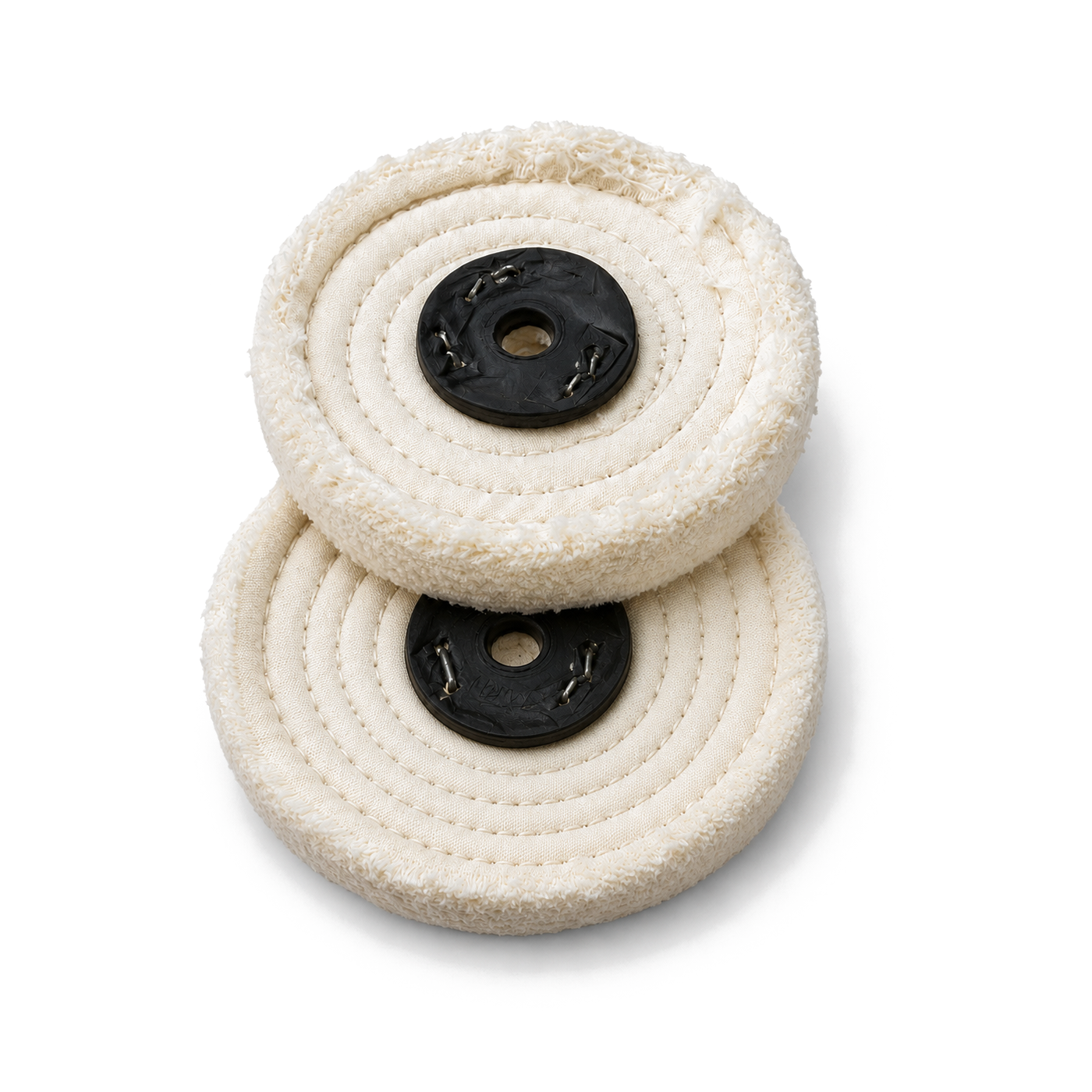
Wheel selection therefore affects the result as much as compound selection. The same LUXI bar can work more softly or more actively depending on wheel material, fabric density, stitching, stiffness, diameter, working width and condition of the wheel surface.
A softer wheel is more suitable for finishing. A more structured and active wheel better supports the first polishing stage, where the task is to form the surface, not simply to add shine.
Why the wheel changes polishing behaviour
The result is affected not only by compound chemistry and not only by hand force. The wheel determines how that force is transmitted to the metal.
The relevant factors are material, fabric density, stitching, stiffness of the working surface, wheel diameter, working width, cleanliness, surface condition and amount of compound on the wheel.
If the wheel is too soft for the task, the first polishing stage may work too weakly. If the wheel is too active, it may create excessive removal, heat and loss of control. If the wheel is contaminated with old compound and removed metal, even the correct compound will work unstably.
How wheels differ in activity
Wheels have their own activity scale. In simplified form, from softest to most active:
white unstitched flannel → white unstitched muslin → white unstitched calico → white stitched muslin → white stitched calico → yellow stitched muslin → sisal wheel
This scale is for understanding the general logic. It does not mean that every wheel is needed in every workflow.
In the LUXI system, unstitched wheels are usually used for finishing. Stitched wheels more often belong to the first polishing stage. A sisal wheel is a tool for the most difficult first-stage cases.
Unstitched wheels: finishing logic
An unstitched wheel is softer and more delicate. It is less inclined to active metal removal and is better suited to smoothing an already formed surface.
In the LUXI system, unstitched wheels are usually used with finishing compounds:
LUXI Super Fine White + clean unstitched finishing wheel
LUXI Orange + clean unstitched finishing wheel
for a more demanding gold finish, especially before coating.
A finishing wheel must not correct abrasive-preparation scratches, waves or shape defects. Those belong to earlier stages.
The logic is explained in:
Difference between the first polishing stage and finishing
Stitched wheels: first polishing stage
Stitching makes the wheel more structured and active. Such a wheel transmits mechanical action more effectively into the contact zone and helps the first polishing stage form the surface.
A basic working example for first-group materials is:
LUXI Blue + white stitched muslin wheel
If this combination works too softly, check not only the compound, but also surface preparation, wheel condition, wheel diameter and interaction area.
More active stitched wheels may be used when a usual white stitched muslin wheel does not form the surface actively enough.
Sisal wheel: difficult first-stage cases
A sisal wheel belongs to the most active tools of the first polishing stage.
For first-group materials, the strongest configuration may be:
LUXI Black + sisal wheel
This is not a universal starting point. It is needed only when the surface, material, contact area and preparation condition truly require strong action.
Sisal may be useful on large planar surfaces, heavy production items and cases where ordinary cotton wheels work too softly. It requires care: if used incorrectly, it can create excessive removal, heat and geometry loss.
Diameter, width and wheel condition
Wheel activity depends not only on fabric and stitching.
Wheel diameter affects linear speed. At the same rpm, a larger wheel moves faster across the surface, generates more heat and acts more strongly in the contact zone.
Working width affects interaction area. A narrow wheel, such as Razor Edge buff, reduces the contact area and helps concentrate action on large planar surfaces.
Wheel condition is also important. A dirty wheel or a wheel overloaded with compound stops working predictably. A new or contaminated wheel must be prepared and cleaned with an abrasive stone.
These topics are explained separately:
Wheel diameter, rpm and linear speed in the contact zone
Why planar items require a more active first polishing stage
Wheel preparation and minimal LUXI compound application
Choosing a wheel for the first polishing stage
For the first polishing stage, first understand what the wheel has to do.
Evaluate:
- the material;
- the quality of surface preparation;
- the size of the contact area;
- whether the selected compound is active enough;
- whether the wheel is active enough;
- whether a larger diameter is needed;
- whether a narrower working zone is needed;
- whether the wheel is overloaded with old compound.
For first-group materials, the compound axis may be:
LUXI Blue → LUXI Yellow → LUXI Gray → LUXI Black
But this axis works together with wheel selection. If the compound is correct but the wheel is too soft, the first polishing stage may still be too weak. If the wheel is too active, removal and loss of control may increase.
Choosing a wheel for finishing
Finishing follows a different logic.
The finishing wheel must be clean, soft and unstitched. Its task is not to form the surface again, but to smooth and stabilize the already formed layer.
The finishing stage must not remove deep scratches, correct waves, remove visible metal, work instead of the first polishing stage or compensate for poor surface preparation.
If the finishing wheel is forced to do the work of the first polishing stage, the previous stage was insufficient.
Typical mistakes
Treating the wheel as only a compound carrier.
In the LUXI system, the wheel remains the working body. Compound helps the contact zone, but it does not replace the wheel.
Adding compound instead of preparing the wheel.
If the wheel has turned black, greasy or overloaded, it must be cleaned with an abrasive stone, not covered with another layer of compound.
Using a finishing wheel for the first polishing stage.
A soft unstitched wheel must not correct preparation scratches or form the surface instead of the working wheel of the first polishing stage.
Using a very active wheel too early.
Sisal and active stitched wheels are not always needed. If the surface is well prepared, an overly active wheel may create unnecessary removal and loss of control.
Mixing compounds on one wheel.
Residue of another compound changes the result and is especially risky on finishing, before coating and on silver.
Ignoring wheel diameter.
The same wheel type may work much more actively or much more softly at a different diameter because of linear speed.
Ignoring working width.
On a large planar surface, too wide a contact zone may weaken the first polishing stage. A narrower wheel, such as Razor Edge buff, can help.
Apply in practice
- Wheel preparation and minimal LUXI compound application
- Basic LUXI production route for first-group materials
- Large planar surfaces: strengthening the first polishing stage
- Final lustre for gold
- Final lustre for silver
- Preparation before plating and coatings
Related articles
- Why the wheel is the working body in the LUXI system
- Difference between the first polishing stage and finishing
- Why planar items require a more active first polishing stage
- Wheel diameter, rpm and linear speed in the contact zone
Mentioned products and tools
LUXI Blue
Basic first-stage polishing compound for first-group materials.
LUXI Yellow
More active first-stage polishing compound for first-group materials.
LUXI Gray
First-stage polishing compound for more demanding first-group tasks.
LUXI Black
The most active first-stage polishing compound for difficult first-group cases.
LUXI Super Fine White
Basic finishing compound for gold and silver.
LUXI Orange
Gold finishing before galvanic coating.
Abrasive stone
Tool for preparing a new wheel and cleaning a working wheel from old compound, removed metal and contamination.
White unstitched finishing wheel
Soft wheel for the finishing stage.
White stitched muslin wheel
Basic working wheel for the first polishing stage.
White stitched calico wheel
More active working wheel for the first polishing stage.
yellow stitched muslin wheel
Active working wheel for strengthening the first polishing stage.
Sisal wheel
The most active wheel for difficult first-stage cases.
Razor Edge buff
Narrow wheel for reducing interaction area and making work on large planar surfaces more controlled.
Main takeaway
In the LUXI system, the wheel is a working tool, not simply a compound carrier.
Wheel selection determines how softly or actively the first polishing stage will work, how clean the finishing stage will be and how stable the surface will remain after washing.
The correct logic is to choose the right wheel, prepare it with an abrasive stone, apply compound minimally, control the contact and not try to replace technology with pressure or excess compound.