
 Integrated Polishing System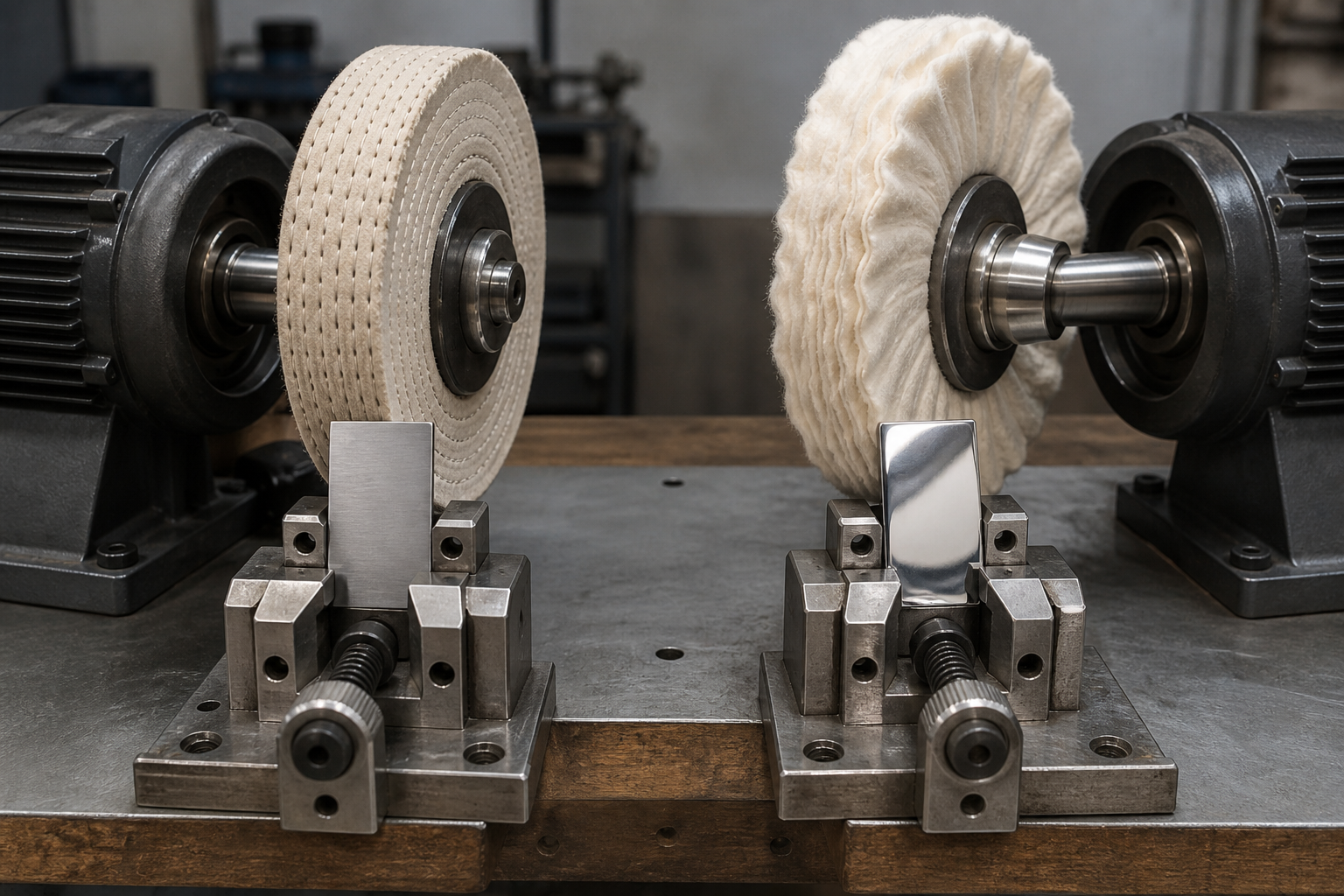
The first polishing stage is the main surface-formation stage. This is where the LUXI system solves some of the problems that conventional abrasive polishing often cannot solve: instead of removing metal deeper and exposing new defects, it helps form a smooth surface layer that can cover part of the shallow volumetric defects and reduce their visual expression.
This is especially important for cast items, 3D prototypes, powder-based technologies, metal 3D printing and metals with fine porosity, weak structure, surface “rash” or defects that continue deeper into the metal. In conventional methods, such defects often do not disappear; they become more visible as metal is removed. The first LUXI polishing stage works differently: it forms the surface with low removal and helps create a more continuous smooth layer, even where small shallow defects remain beneath it.
The finishing stage does not replace this work. Its task is to further smooth and stabilize the already formed surface, reduce micro-defects, smooth small wavy areas in the surface layer and bring the item to the final quality of lustre.
Why this matters
If the surface has not yet been formed, the finishing compound will not solve the problem. It may temporarily improve appearance, but after washing, ultrasonic washing or preparation for coating, the defects can reappear.
This is especially important before decorative, protective or galvanic coating. A coating follows the condition of the surface onto which it is applied. If the surface is unstable, contains micro-defects, preparation marks or poorly withstands washing, the coating has a weak base.
Finishing is therefore not simply “making it shiny.” It is the smoothing and stabilization of an already formed surface.
The first polishing stage
The first polishing stage begins after sanding and abrasive preparation. By that point the shape of the item should already be corrected, and gross shape defects should be removed.
The tasks of the first polishing stage are to remove scratches from abrasive preparation, form a smooth metal surface layer, reduce the visual expression of small shallow volumetric defects, close part of the surface-connected micro-defects by forming a new surface layer, create an even base for finishing and preserve mass, relief and geometry.
The boundary of this effect must be understood. LUXI does not “heal” the metal in depth and does not remove large casting cavities, deep porosity or destroyed structure. But on a correctly prepared surface, the first polishing stage can significantly improve the appearance and stability of the near-surface zone without rough abrasive removal.
For first-group materials, the first-stage axis usually follows:
LUXI Blue → LUXI Yellow → LUXI Gray → LUXI Black
This axis belongs to the first polishing stage. It must not be automatically transferred to finishing compounds.
The finishing stage
The finishing stage begins only after the first polishing stage has formed the surface. There should be no remaining scratches from abrasive preparation, coarse sanding marks, obvious shape defects or areas where the surface has not yet been closed by the first polishing stage.
The tasks of the finishing stage are to further smooth the already formed surface, reduce micro-defects, smooth small wavy areas of the surface layer, improve lustre stability, prepare the surface for gentle washing, improve the base before decorative or galvanic coating and produce a clean final lustre.
A finishing compound must not perform the work of the first polishing stage. It is not intended to remove abrasive-preparation scratches or to close obvious volumetric defects. Its role is to improve, smooth and stabilize the layer that was already formed during the first polishing stage.
Why the stages must not be exchanged
If the surface has not yet been formed, a finishing compound may give a temporary feeling of shine, but it will not create the correct base. After washing, ultrasonic washing or coating preparation, defects may reappear.
If scratches from abrasive preparation, fine porosity, unstable zones or surface “rash” remain, first return to the first polishing stage and form the surface correctly. Only then does it make sense to move to finishing.
A sign of a wrong workflow is when the finishing compound starts doing the work of the first polishing stage. In that case, do not make the finishing stage stronger; check surface preparation, first-stage compound selection, wheel condition and the workflow itself.
Especially difficult cases
In especially difficult cases, where the surface contains pronounced near-surface defects, a cross-direction preparation and first-stage polishing scheme can be used.
At the final sanding stage, the item surface is systematically prepared with 800 grit abrasive using parallel movements in one direction. This creates parallel grooves — 800 grit abrasive scratches — on the surface.
After this, the first LUXI polishing stage is performed at 90° to the direction of those grooves. This cross-direction logic helps activate the surface layer and strengthen the work of the first polishing stage when a denser and more stable surface layer must be formed.
The detailed instruction is given in the practical card:
Items with volumetric and hidden defects after casting, 3D prototypes and powder-based technologies
Main rule: difficult defects are not solved by finishing compound, but by a correctly built first polishing stage.
Why finishing is connected with washing
A good shine immediately after polishing does not yet mean that the surface is stable. After finishing, the item must be washed, and sometimes prepared further before coating.
If the finishing stage has not stabilized the surface sufficiently, aggressive ultrasonic washing, high solution temperature, strong degreasers or excessive time in the ultrasonic bath may partially damage the formed surface layer.
On silver this can appear as a milky or cloudy surface after washing. On gold, hidden scratches or micro-relief that seemed closed immediately after polishing may reappear.
Finishing and washing must therefore be treated as one sequence.
Gold
For gold, the basic finishing scheme is:
LUXI Super Fine White + clean unstitched finishing wheel
For a more demanding gold finish, especially when the item will receive galvanic coating after polishing, use:
LUXI Orange + clean unstitched finishing wheel
LUXI Orange is not simply a more aggressive version of LUXI Super Fine White. It is a different finishing tool: it helps produce a finer and more stable finish, especially before coating and subsequent washing.
Silver
Silver is especially sensitive to the condition of the finish and to subsequent ultrasonic washing.
If the surface is not sufficiently stabilized, aggressive washing can reduce lustre, create a milky surface and lead to re-polishing after washing.
For silver it is especially important to complete the first polishing stage before moving to finishing, use a clean unstitched finishing wheel, apply finishing compound minimally, not use finishing to replace inadequate preparation, and use short and gentle washing after finishing.
Before coating
Before decorative, protective or galvanic coating, the item must pass through all technological stages in the correct sequence: sanding removes shape defects and activates the surface; the first polishing stage removes abrasive-preparation scratches and forms a smooth metal surface layer; finishing smooths and stabilizes the formed surface; washing removes compound residue, removed metal and contamination without damaging the obtained surface layer.
If any stage is skipped or performed incorrectly, the coating may lie unevenly, adhere poorly or be more likely to delaminate.
How to tell that it is too early to move to finishing
Do not move to finishing if scratches from abrasive preparation are visible, the surface still has waves or broken geometry, the surface has open defects that should be closed by the first polishing stage, shine appears only with excess compound, the surface becomes cloudy after short work, the wheel is contaminated or overloaded, the result worsens after washing, or the finishing compound has to “fix” what should have been done by the first polishing stage.
In these cases, return to the previous stage.
Apply in practice
- Basic LUXI production route for first-group materials
- Wheel preparation and minimal compound application
- Final lustre for gold
- Final lustre for silver
- Preparation before plating and coatings
- Washing after LUXI polishing
Mentioned products
LUXI Super Fine White
Basic finishing compound for gold and silver.
LUXI Orange
Gold finishing before galvanic coating.
iClean
Short, gentle washing after LUXI polishing.
Main takeaway
The first LUXI polishing stage forms the surface and solves near-surface defect problems that conventional abrasive polishing often intensifies by further metal removal.
The finishing stage does not correct the first polishing stage. It smooths and stabilizes the already formed surface, makes the lustre cleaner and helps the surface better withstand washing and subsequent coating.