
 Integrated Polishing System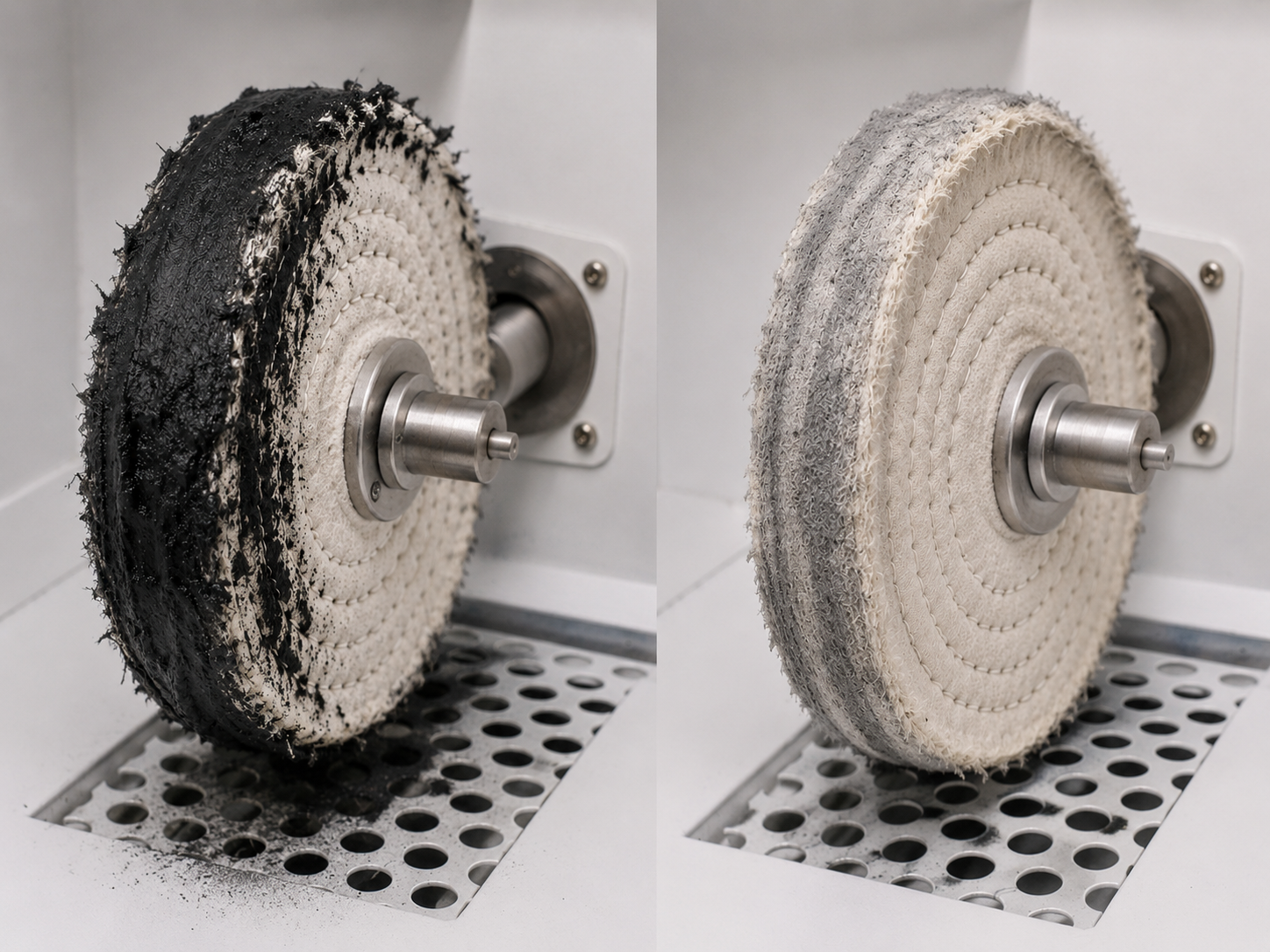
This is especially important before finishing, washing, galvanic coating, decorative coating and work in relief. If the surface looks shiny but contains compound residue and removed metal, that shine may be unstable. After washing, ultrasonic treatment or coating, problems may reappear.
Why process cleanliness matters
Polishing always leaves traces of the working process. On the surface and in relief there may be:
- compound residue;
- removed metal;
- contamination from the wheel;
- abrasive micro-particles;
- friction products;
- contamination from recesses and undercuts.
If these residues are removed quickly and the surface remains stable after washing, the process has been built correctly. If the surface becomes cloudy after washing, scratches open, lustre is lost or re-polishing becomes necessary, the cause is often earlier in the workflow: an overloaded wheel, excess compound, an incorrect finishing stage or overly aggressive ultrasonic washing.
Why LUXI compounds wash off faster
LUXI compounds have a water-rinsable base. This is an important part of their technological logic.
Because of the specific chemistry of the base, the combination of surfactants and other chemical additives helps compound residue transfer into the water phase and be removed more quickly from the surface, relief and recesses.
This does not mean that washing is unnecessary. After polishing, the item still carries compound residue, removed metal and contamination from the contact zone. But a correctly built LUXI polishing process usually requires shorter and gentler washing than work with traditional greasy compounds, which are harder to remove from the surface and from relief.
This is why the LUXI system depends on the combination:
minimal compound application + clean wheel + water-rinsable compound base + short gentle washing
If too much compound has been applied, or the wheel is overloaded with old compound and removed metal, even a water-rinsable base cannot fully save the process. Washing becomes longer, relief clogs more strongly, and the risk of damaging the formed surface layer in ultrasound increases.
Why an overloaded wheel is dangerous
When old compound, removed metal and contamination accumulate on the wheel, the wheel stops working as a clean tool. An intermediate layer appears between the wheel and the item, reducing process control.
As a result:
- the surface may look shiny but unstable;
- relief and recesses become clogged with compound;
- washing becomes more difficult;
- the risk of a cloudy surface after ultrasound increases;
- finishing may be partially damaged during washing;
- coating receives a less stable base.
In the LUXI system, it is better to refresh the working surface of the wheel with an abrasive stone more often than to keep applying fresh compound on top of old residue.
The practical instruction is given in the workflow card:
Wheel preparation and minimal LUXI compound application
Why minimal compound application is connected with cleanliness
Minimal compound application is needed not only to control metal removal. It also helps keep the process clean.
If there is too much compound, it does not strengthen the LUXI system. It creates excess material in the contact zone, mixes with removed metal and starts contaminating the item.
The correct logic is:
- the wheel is prepared;
- compound is applied minimally;
- the working zone remains open;
- the wheel maintains contact with the surface;
- after polishing, residue can be removed gently and quickly.
Such a process gives a more stable surface and reduces the load on washing.
Finishing and surface cleanliness
The finishing stage must not simply “cover” the surface with shine. Its task is to smooth and stabilize an already formed surface.
If finishing is performed correctly, the surface better withstands subsequent washing and preparation before coating. If finishing is performed on a dirty wheel, with excess compound, or instead of an incomplete first polishing stage, the surface may look good immediately after polishing but worse after washing.
Finishing and washing must therefore be treated as a connected pair.
This is explained in the article:
Difference between the first polishing stage and finishing
Why washing can damage the surface
Ultrasonic washing is not a problem by itself. The problem is overly aggressive washing or an attempt to compensate for dirty polishing by washing more aggressively.
The surface may worsen if the solution temperature is too high, the time in the ultrasonic bath is too long, degreasers are too aggressive, cavitation is too strong, the mode is unsuitable for a sensitive item, or washing is used to remove from relief an excess of compound that should not have been there after correct application.
In the LUXI system, washing should be short, gentle and controlled. Its task is to remove compound residue, removed metal and contamination without damaging the formed surface layer.
The practical workflow is:
Silver and the risk of a cloudy surface
Silver is especially sensitive to the wrong sequence of finishing and washing.
If the surface is not sufficiently stabilized, or washing is too aggressive, a cloudy or milky surface may appear after ultrasound. This does not necessarily mean that the compound was bad. Often it means that the surface was not formed or stabilized sufficiently before washing, or that washing itself was too harsh.
For silver, it is especially important to complete the first polishing stage before finishing, use a clean unstitched finishing wheel, apply finishing compound minimally, avoid overloading the item with compound residue, and wash briefly and gently.
Gold and hidden scratches after washing
On gold, scratches or micro-relief that were hard to see immediately after polishing may appear after washing. This may happen if the shine was partly created by a contaminated compound film, or if the finishing stage tried to replace an incomplete first polishing stage.
In the correct sequence, the first polishing stage forms the surface, finishing stabilizes it, and washing checks the result. If the surface becomes worse after washing, the answer is not to add more finishing compound, but to analyze the previous stages.
Before coating
Before galvanic, decorative or protective coating, surface cleanliness is especially important.
A coating follows and amplifies the condition of the surface onto which it is applied. If compound residue, removed metal, contamination or an unstable finishing layer remain on the surface, the coating may lie less evenly, adhere less stably or have a higher risk of delamination.
Before coating, the item must pass through the correct sequence:
- abrasive preparation;
- first polishing stage;
- finishing;
- gentle controlled washing;
- inspection after washing;
- only then preparation and coating.
The practical card is:
Preparation before plating and coatings
Relief, brushes and recesses
In relief and recesses, compound residue is especially dangerous because it is harder to see and remove.
This is important when working with LUXI Purple, a brush, thread or cord. LUXI Purple holds better on a fibrous carrier and helps transfer compound into complex geometry. But after such work, relief must be carefully checked and washed.
The goal is not to fill the relief with compound. The goal is to deliver compound into the working zone, perform short controlled work and then remove residue.
Typical mistakes
Compensating for dirty work with more aggressive washing.
If there is too much compound and removed metal, it is better to correct the polishing process than to make the ultrasonic washing stronger.
Adding compound to a dirty wheel.
Fresh compound on top of old residue does not restore control. First refresh the working surface of the wheel with an abrasive stone.
Treating pre-wash shine as the final result.
The surface must be evaluated after washing, especially before coating.
Using finishing instead of the first polishing stage.
Finishing must not cover scratches or preparation errors. It stabilizes a surface that has already been formed.
Leaving compound in relief.
Compound residue in recesses can reduce appearance, complicate later processing and interfere with coating.
Apply in practice
- Wheel preparation and minimal LUXI compound application
- Washing after LUXI polishing
- Final lustre for gold
- Final lustre for silver
- Preparation before plating and coatings
- LUXI Purple for brushes, cord, thread, relief and recesses
Related articles
- Why the wheel is the working body in the LUXI system
- Difference between the first polishing stage and finishing
- Small tools and low-temperature polishing
- Logic of polishing wheel selection in the LUXI system
Mentioned products
LUXI Super Fine White
Basic finishing compound for gold and silver.
LUXI Orange
Gold finishing before galvanic coating.
LUXI Purple
Compound for brushes, cord, thread, relief and recesses.
iClean
Controlled washing after LUXI polishing.
Abrasive stone
Tool for refreshing the working surface of the wheel.
Main takeaway
Clean polishing is not just good shine before washing.
LUXI compounds have a water-rinsable base: the combination of surfactants and other chemical additives helps remove compound residue faster in an aqueous environment. After a correctly performed LUXI polishing process, washing can therefore be shorter and gentler than after traditional greasy compounds.
But this works only inside the whole system: clean wheel, minimal compound application, correctly performed first polishing stage, correct finishing and short controlled washing.
If the wheel is overloaded, there is too much compound or the surface is poorly prepared, washing is forced to correct polishing mistakes. The LUXI system is not meant to work that way.