
 Integrated Polishing System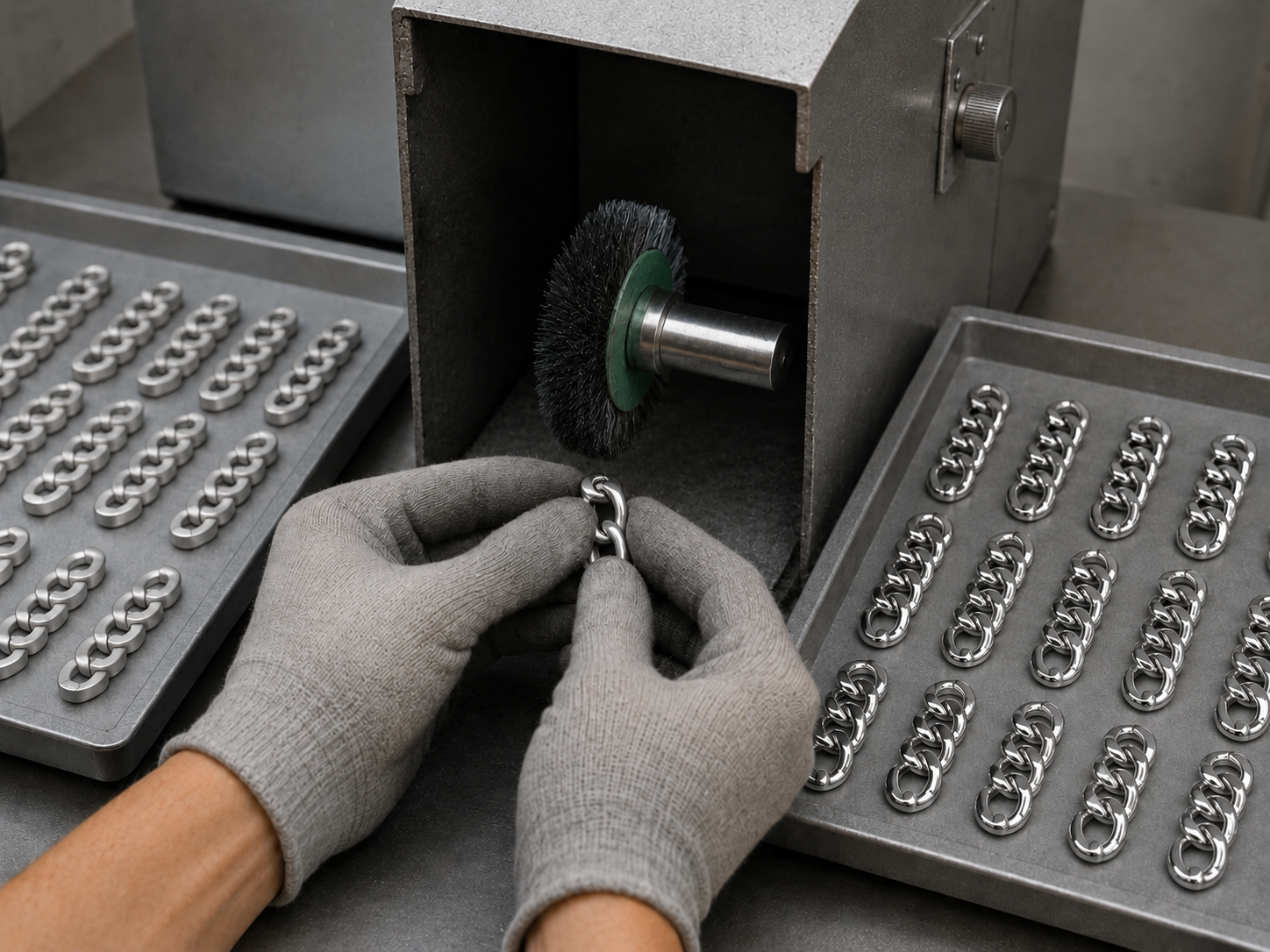
This workflow differs from work with LUXI Green. LUXI Green is better suited to controlled low-temperature work on cotton and felt small tools, especially inside a ring. LUXI Purple is used where bristles, fibres, compound retention on the carrier and transfer of compound into complex geometry are important.
When to use this workflow
This workflow applies to LUXI Purple on brushes, thread, cord and other fibrous carriers.
Typical cases include relief surfaces, recesses, undercuts, areas around decorative elements, zones that a normal polishing wheel cannot reach, chains and links, inner geometry with limited access, areas where compound must hold on bristles or fibres, and cases where compound must be carried into relief while keeping its working action in the contact zone.
The main task is to deliver compound into a hard-to-reach area and provide controlled local work where an ordinary wheel cannot create correct contact.
Why LUXI Purple is used
When working with a brush, thread or cord, compound activity is not the only important factor. The compound also has to stay on the carrier.
If compound does not hold on bristles or fibres, it falls away, does not reach the working zone or works for too short a time. In relief and recesses this is especially noticeable: the tool touches the item, but the compound is not transferred to the place where it must work.
LUXI Purple holds better on bristles, cotton thread or cord than LUXI Green. This matters because the fibrous carrier has to bring the compound into relief, a recess or an undercut and preserve working action in the contact zone.
What you need
- LUXI Purple;
- a suitable brush, cotton thread, cotton cord or another fibrous carrier;
- a tool with controlled rpm;
- a correctly prepared item surface;
- the ability to check relief and recesses after work;
- gentle washing after polishing, if the item construction and materials allow it.
The tool must be clean. Old compound, removed metal and contamination may change the action of LUXI Purple and make later washing more difficult.
Surface preparation
Before using LUXI Purple, the surface must be prepared.
LUXI Purple does not replace sanding, shape correction or the main first polishing stage where a correctly selected polishing wheel can be used. Its task is work in complex geometry and hard-to-reach zones.
If coarse scratches, casting defects, waves or preparation marks remain, first determine whether this zone truly belongs to brush work. If the defect should be removed before polishing or during the first polishing stage, LUXI Purple must not be used to compensate for an unprepared surface.
Applying compound
Apply LUXI Purple to the brush, thread or cord moderately and with control.
There must be enough compound for it to remain on the carrier and be transferred into the working zone. But the tool must not be overloaded with compound.
If there is too much LUXI Purple, compound can clog relief, recesses become dirty, the brush starts smearing compound, the surface may look cloudy, too much residue remains after polishing and washing becomes more difficult.
If there is too little compound, it does not stay on the carrier and does not reach the working zone.
Working with a brush
The brush must deliver compound into relief and recesses, not roughly cut the surface.
Work with short passes, avoid excessive pressure, do not stay too long in one zone, make sure the brush does not damage edges or fine elements, regularly check that relief is not becoming clogged with compound, and control whether the compound reaches the needed area.
If the result is unstable, first check the brush, compound amount, pressure, access to the working zone and surface preparation.
Working with thread or cord
Cotton thread or cord is useful where a narrow channel, a space between elements or a zone inaccessible to a wheel or felt attachment must be reached.
LUXI Purple helps the compound stay on the fibre and be transferred into the narrow working zone.
Use clean thread or cord, apply LUXI Purple moderately, do not create a thick compound layer, work with short controlled movements, check whether compound remains in recesses, and always check washing after work.
Thread or cord must not be used as a rough abrasive tool. Their task is to carry compound locally and provide controlled action in a complex zone.
If the result is reached slowly
If the result is reached slowly, first check whether the brush, thread or cord creates the correct working contact in the needed zone.
For LUXI Purple, it is not enough that compound is present on the carrier. It must reach the relief, recess or undercut and preserve its working action in the contact zone.
Check whether LUXI Purple stays on the brush, thread or cord, whether the carrier is clean enough, whether the brush is suitable in stiffness and shape, whether the tool reaches the needed zone, whether the contact is long and stable enough, whether the surface is sufficiently prepared and whether the zone requires preliminary work with another tool.
Compounds designed for polishing wheels usually do not solve this task. They hold worse on a brush or fibre, transfer worse into relief and lose their action faster in hard-to-reach zones.
Correct check: clean carrier, moderate application of LUXI Purple, suitable brush or cord, short repeatable passes and control that the compound is working in the intended zone.
Why LUXI Asian Blue is not the ordinary next step
LUXI Asian Blue is not the ordinary next step after LUXI Purple.
It is a separate scheme for more rigid brush work in difficult recesses, wedge-like gaps or zones with open porosity. It must not be used as a universal strengthening step if LUXI Purple works slowly.
The usual logic is:
- LUXI Green — cotton, felt, inside of a ring, controlled low-temperature work;
- LUXI Purple — brush, cord, thread, relief, recesses, compound retention on the carrier;
- LUXI Asian Blue — a separate scheme for a rigid brush and difficult recesses when it is truly needed.
Washing after LUXI Purple
Washing is especially important after working with LUXI Purple.
Good retention on a brush or cord helps during polishing, but after work the relief must be checked carefully for remaining compound.
After polishing, check recesses, undercuts, areas around stones, gaps between links, inner channels, decorative relief and any places where compound could enter but be difficult to remove.
For controlled washing after polishing, the LUXI system uses iClean where the material, stones, coating and construction of the item allow it.
The washing logic is explained in:
Typical mistakes
Replacing LUXI Purple with compound designed for a polishing wheel.
In relief, on a brush, thread or cord, those compounds often do not stay on the carrier and do not provide the required action in recesses. LUXI Purple is used for these tasks.
Confusing the tasks of LUXI Green and LUXI Purple.
LUXI Green is used for cotton and felt small tools, especially inside a ring. LUXI Purple is used for brushes, cord, thread, relief and recesses, where retention on a fibrous carrier and transfer into complex geometry matter.
Applying too much compound.
Excess LUXI Purple can clog relief and make washing more difficult.
Using an unsuitable brush.
If the brush is too soft, it may not carry compound into the needed zone. If the brush is too stiff, it may work roughly and leave marks on sensitive elements.
Washing the item insufficiently after work.
Compound residue in recesses can reduce the appearance of the item and interfere with further processing.
Moving to LUXI Asian Blue without a reason.
LUXI Asian Blue is a separate scheme for more rigid brush work, not the ordinary next step after LUXI Purple.
Apply in practice
- Small tools and low-temperature polishing
- LUXI Green on cotton and felt small tools
- Chains, relief and hard-to-reach zones: brush polishing with LUXI
- Washing after LUXI polishing
Mentioned products and tools
LUXI Purple
Compound for brushes, cord, thread, relief and recesses where retention on the carrier and local action in complex geometry matter.
LUXI Green
Compound for controlled low-temperature work on cotton and felt small tools.
LUXI Asian Blue
Separate scheme for a rigid brush and difficult recesses.
iClean
Controlled washing after polishing, if the material and construction of the item allow it.
Brush
Tool for relief, recesses, undercuts and zones a wheel cannot reach.
Cotton thread or cord
Fibrous carrier for transferring compound into narrow and hard-to-reach zones.
Main takeaway
LUXI Purple is used where brush, cord, thread, relief, recesses and compound retention on the carrier matter.
Its task is to help transfer compound into complex geometry and preserve working action where an ordinary wheel cannot enter.
Correct work is based on a clean carrier, moderate application of LUXI Purple, short controlled passes and careful washing of relief after polishing.