
 Integrated Polishing System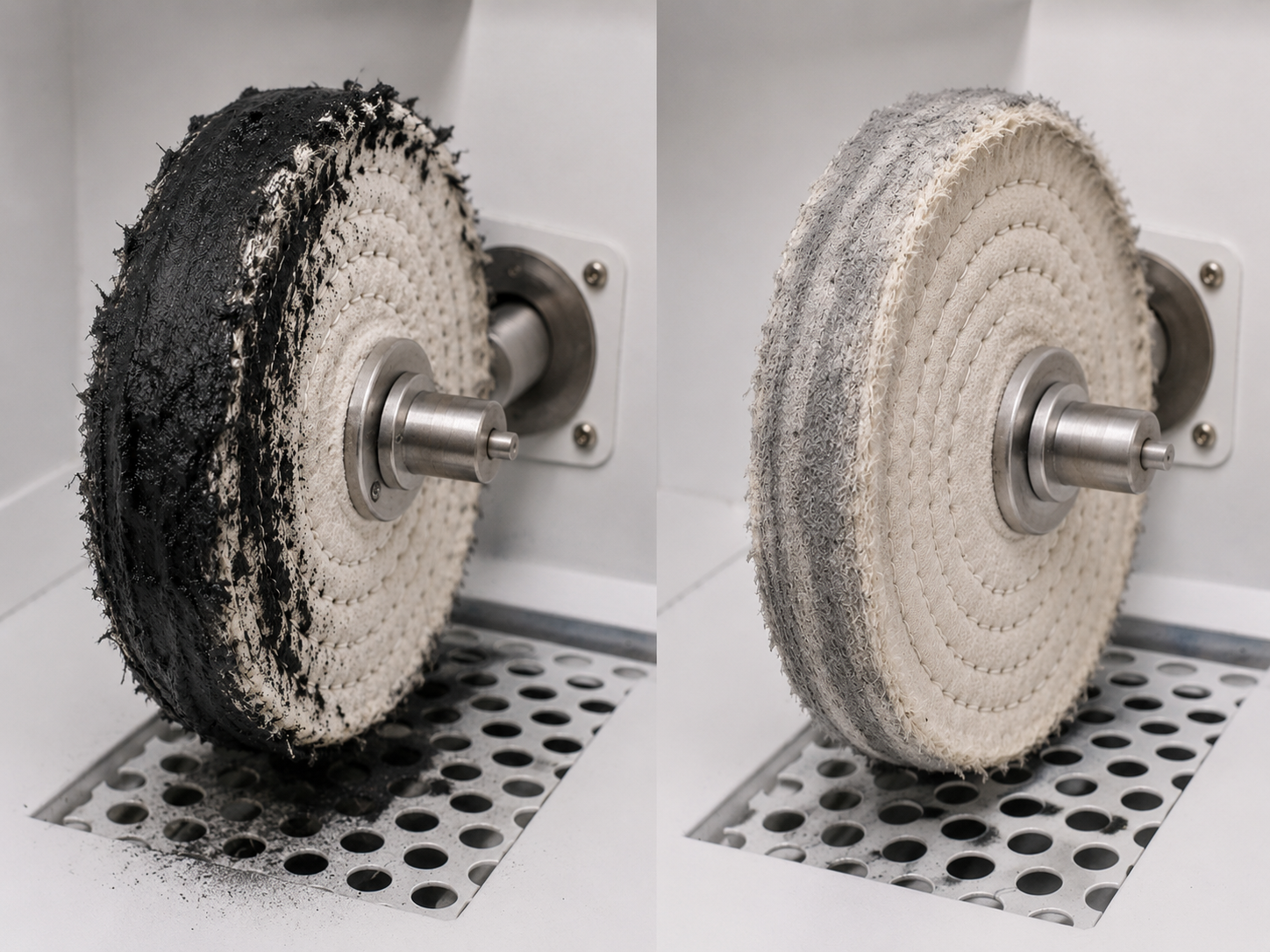
More compound does not mean better polishing. In the LUXI working process, an overloaded wheel loses controlled contact, suppresses the effect of forming a smooth metal surface layer, replaces it with abrasive action and can slow surface formation. First clean the wheel completely, then add compound with a single touch.
The polishing wheel remains the working body of the process. LUXI compound is applied in a very small amount: it activates the contact zone and helps the wheel work with the metal surface, but it must not become a thick working layer between the wheel and the item.
When this workflow is needed
Use this workflow whenever you work with LUXI compounds. It is especially important before using a new wheel for the first time, after several compound applications, when the wheel becomes dark, black, sticky or greasy, when compound starts clogging relief, or when adding compound no longer improves the result.
Main rule: if the process starts going wrong, check the wheel first instead of adding more compound.
What is used to prepare the wheel
Use an abrasive stone, usually silicon carbide, to prepare and refresh the wheel.
It is not only for new wheels. During work it removes old compound, removed metal and contamination, slightly opens the working surface and cuts long loose threads.
Preparing a new wheel
Do not overload a new wheel with compound.
First mount the wheel safely and bring it to working speed. Then gently dress the working surface with the abrasive stone. The goal is not to remove a lot of wheel material, but to open the working surface, remove an overly dense factory surface, cut loose threads and make the contact more predictable.
After preparation, the wheel should look dry, clean and even. Only then should LUXI compound be applied.
Minimal compound application
Apply LUXI compound with one short touch to the rotating wheel.
The compound must reach the wheel, but it must not form a visible thick layer. In the LUXI Blue test on a white stitched wheel, correct application means that the bar has been touched lightly, but the stopped wheel does not look visibly blue.
If the stopped wheel shows obvious coloured compound marks, there is already too much compound.
Why an overloaded wheel slows the LUXI process
If there is too much compound, old residue and removed metal on the wheel, a dirty intermediate layer appears between the wheel and the item.
The wheel no longer works directly with the metal surface. Controlled contact is lost, abrasive action begins to replace surface formation, geometry control becomes worse, the surface may become cloudy, compound clogs relief and recesses, washing becomes more difficult and the final result can be slower and less stable.
Correct recovery sequence
If the result becomes cloudy, dirty or unstable, do not start by increasing pressure and do not add fresh compound on top of old residue.
Correct sequence:
- Stop and check the wheel condition.
- Clean the wheel completely with the abrasive stone.
- Remove old compound, removed metal and contamination.
- Return the working surface to a dry light-grey condition.
- Add fresh LUXI compound with one short touch.
- Continue with short controlled passes.
When to continue
Continue to main work or the next stage only when the wheel is clean, dry, not overloaded with compound, free of long loose threads, not leaving dirty marks, running evenly and predictably, and taking compound minimally and evenly.
Apply in practice
- Basic LUXI production route for first-group materials
- Large planar surfaces: strengthening the first polishing stage
- Final lustre for gold
- Final lustre for silver
- Preparation before plating and coatings
Related articles
- Why the wheel is the working body in the LUXI system
- Logic of polishing wheel selection in the LUXI system
- Wheel diameter, rpm and linear speed in the contact zone
Mentioned products and tools
LUXI compounds
Used in a minimal amount. The exact compound is selected by material, stage and task.
Abrasive stone
Tool for preparing a new wheel and cleaning a working wheel from old compound, removed metal and contamination.
White stitched muslin wheel
Typical working wheel for the first polishing stage on first-group materials.
Clean unstitched finishing wheel
Wheel for the finishing stage after the surface has already been formed.
Main takeaway
In the LUXI system, more compound does not mean better work.
Clean the wheel completely first. Then add LUXI compound with one short touch and let the wheel work directly with the metal surface.