
 Integrated Polishing System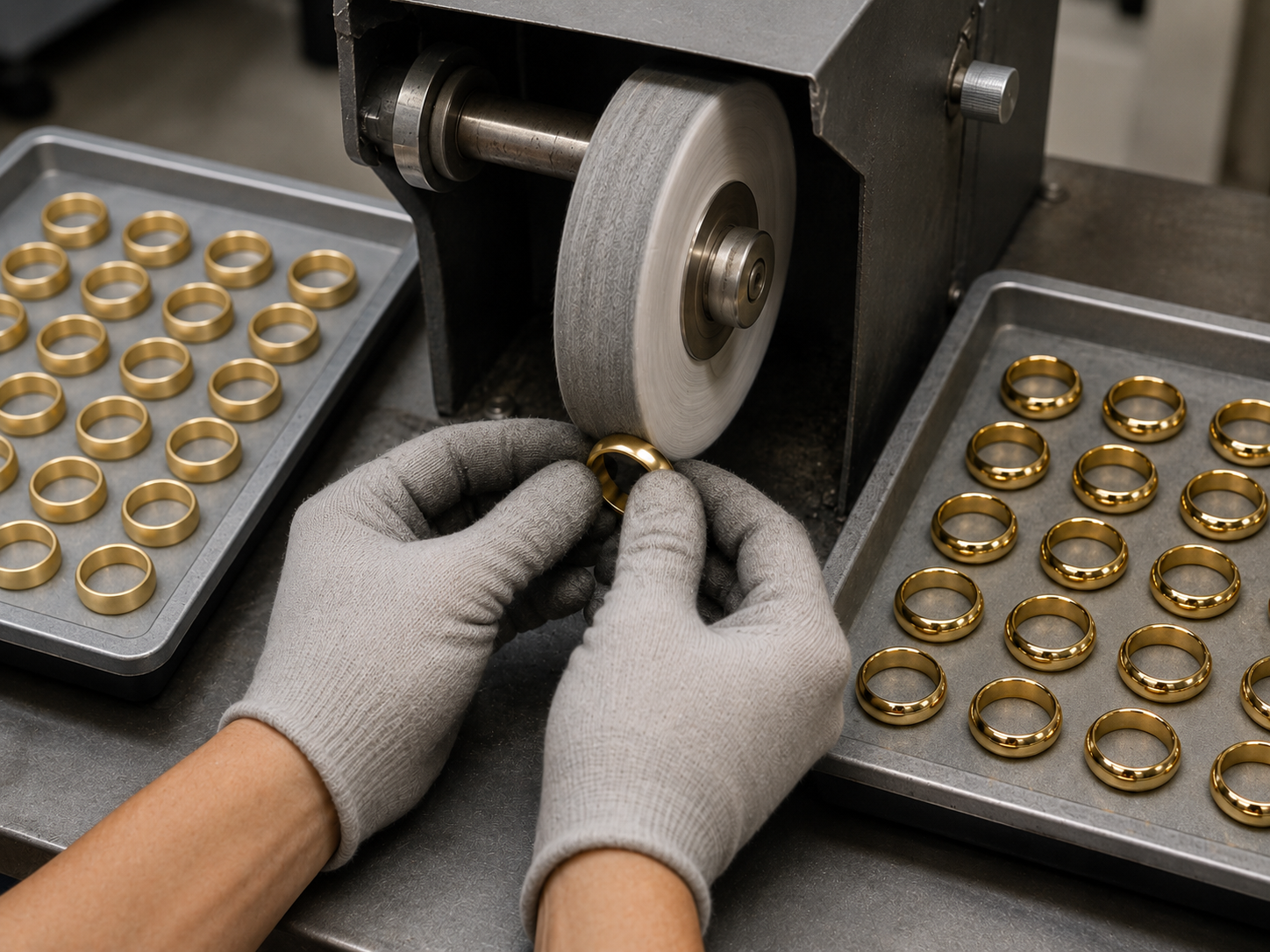
The route is intended for an item that has already passed surface preparation and is ready for the first polishing stage. If deep scratches, coarse preparation marks, waves or geometry errors remain on the item, return to surface preparation first.
Main route logic
A LUXI production route has two different tasks.
The first polishing stage forms the surface: it removes scratches from abrasive preparation, creates a smooth metal surface layer and prepares the item for finishing.
The finishing stage does not replace the first polishing stage. Its task is to smooth and stabilize the already formed surface, bring it to final lustre quality and prepare it for washing or coating.
When this workflow is needed
Use this workflow as the starting logic for typical items made of gold, silver, bronze and brass.
Typical cases:
- ordinary production polishing of first-group materials;
- choosing the starting compound + wheel pair;
- moving from a prepared surface to finishing;
- setting up a route for a batch of items;
- training an operator in the basic LUXI logic.
First polishing stage
If the item is prepared, the basic route can start with:
LUXI Blue + white stitched muslin buff
LUXI Blue is the basic starting compound for first-group materials when the surface is already prepared and does not require aggressive shape correction.
If LUXI Blue works too slowly or does not give a stable result, especially on large planar surfaces or hard alloys, the first polishing stage is intensified by moving to a more active compound and/or a more active wheel.
The first-polishing-stage axis for first-group materials:
LUXI Blue → LUXI Yellow → LUXI Gray → LUXI Black
This does not mean that all compounds are used one after another. A more active compound usually replaces the previous first-polishing-stage option when the task requires more activity.
Most active configuration
The most active configuration of the first polishing stage in this logic is:
LUXI Black + sisal wheel
This setup is needed only for genuinely difficult cases: large planar surfaces, hard alloys, difficult preparation or a production task where a softer setup does not provide the required speed and repeatability.
Before LUXI Black + sisal, the surface must be prepared finer than for an ordinary item: at least to 800 grit, and in more demanding cases to 1000 grit.
LUXI Black + sisal is not a universal starting point. If it is used unnecessarily, it can cause excessive metal removal, weaken control of flatness and damage the item geometry.
Production logic
The softest successful setup is not always the best production setup. On a single item, an experienced jeweller may obtain a good result with a softer pair. In serial work, speed, repeatability, the average operator’s skill level and the reduction of rework also matter.
Therefore the production route is chosen as a balance between metal preservation, speed, stability, surface quality and acceptable metal removal.
Finishing stage
Move to finishing only after the surface has already been formed. Finishing compound must not be used to correct scratches from abrasive preparation, waves or geometry errors.
Use a clean unstitched finishing wheel for finishing.
For gold, the basic finish is LUXI Super Fine White + clean unstitched finishing wheel. For a more demanding finish, especially before electroplated coating, LUXI Orange + clean unstitched finishing wheel is preferable.
For silver, the basic finishing setup is LUXI Super Fine White + clean unstitched finishing wheel, with special control of subsequent washing.
Finishing compounds should not be understood as a simple aggressiveness scale. They differ in surface quality, stability before coating, cleanliness after washing and suitability for the next operation.
Washing
After polishing, wash the item and inspect it under light. If iClean is used, apply short washing time, suitable concentration and moderate temperature.
Washing must not damage the surface formed by the first polishing stage and stabilized by finishing.
Next step
If the surface is not yet ready for polishing, start with “Surface preparation before LUXI.”
If the result is unstable because the wheel is overloaded or too much compound is being used, use “Wheel preparation and minimal LUXI compound application.”
If the item has a large planar surface, use “Large planar surfaces: intensifying the first polishing stage.”
After finishing, proceed to “Washing after LUXI polishing” or “Preparation before electroplating and coatings” if the item will be coated.