
 Integrated Polishing System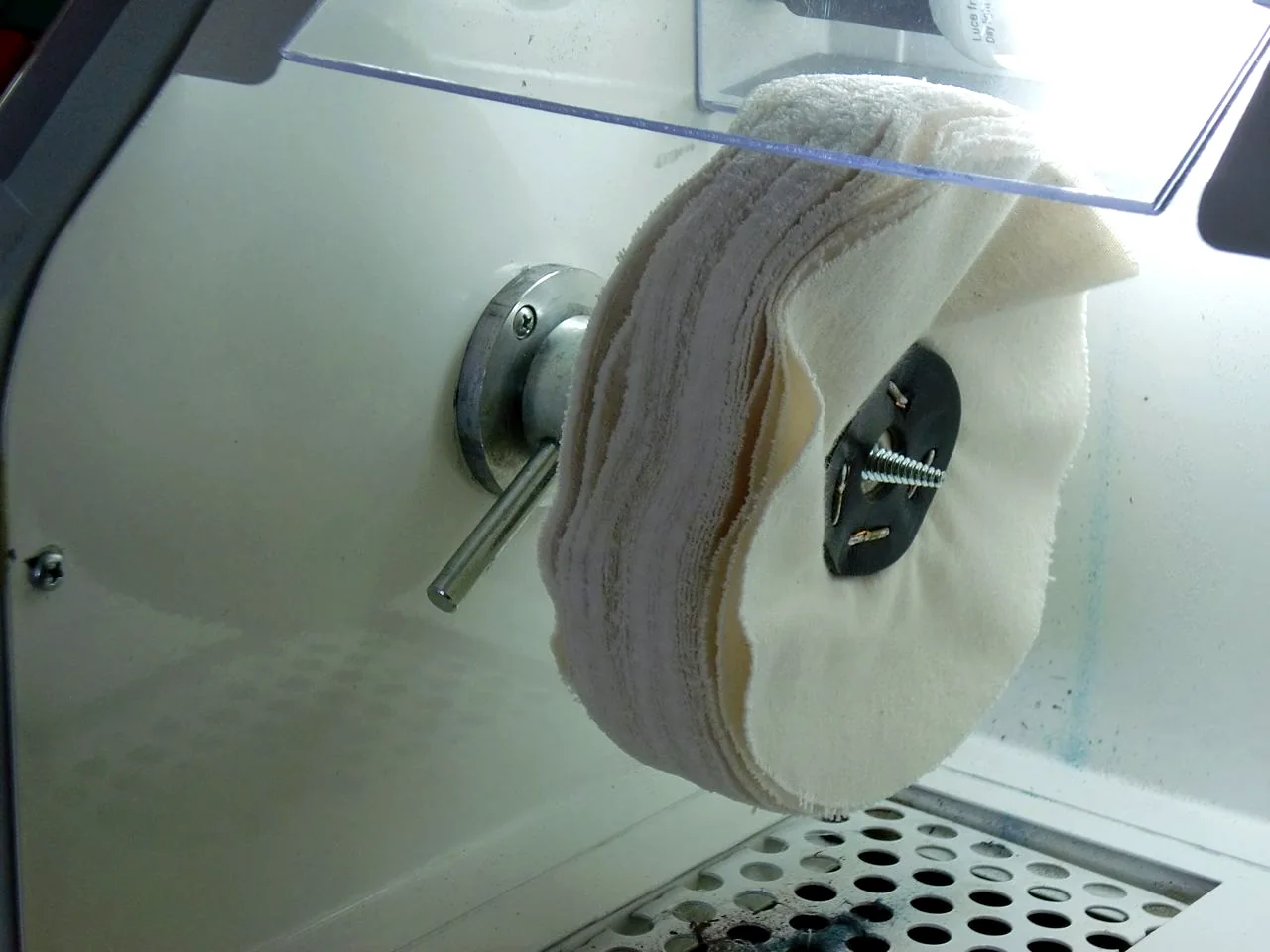
This differs from the familiar logic of conventional polishing, where the operator often sees the compound as the main working material: the more compound is on the wheel, the more active the polishing should be. In the LUXI system, that habit interferes with the process.
What happens in the contact zone
Polishing is not defined only by average pressure or by the amount of compound on the wheel. The real work happens in the contact zone between the tool and the item surface. This is where local pressure, friction, shear, heat and the interaction between compound, wheel and metal take place.
In a correct LUXI process, the wheel maintains direct, controlled contact with the surface. The compound is present in the contact zone in a small amount and helps activate the metal surface layer. The surface is not simply cut away by abrasive action; it is gradually formed into a smoother and more stable surface layer.
If too much compound is used, the contact changes. A layer of compound, removed metal and contamination appears between the wheel and the item. At that point the wheel stops working as a controlled tool, and the process returns to ordinary abrasive logic, with higher removal and poorer geometry control.
What LUXI compound does
LUXI compound must not work instead of the wheel. Its role is to support the correct condition of the contact zone.
It helps to:
- activate the metal surface layer;
- support shear interaction between the wheel and the surface;
- reduce rough abrasive removal;
- make surface formation more controllable;
- reduce the risk of geometry loss when used correctly.
The compound is necessary, but it must be used sparingly. In the LUXI system, excess compound does not strengthen the process; it disrupts it.
Why excess compound interferes
Excess compound creates several problems.
The wheel stops interacting directly with the metal. Its working surface becomes covered with a mixture of old compound, removed metal and contamination. That layer begins to behave like a dirty abrasive mass.
As a result, metal removal increases, geometry control becomes worse, the surface may become cloudy, the wheel darkens quickly, compound may clog relief and recesses, the result becomes less predictable, and washing after polishing becomes more difficult.
If the result becomes worse, the correct action is not to add more compound. The correct action is to restore the wheel to the proper working condition.
Why wheel condition matters
In the LUXI system, the wheel is not a passive compound carrier. It is part of a technological pair:
prepared wheel + minimal amount of original LUXI compound + correctly prepared item surface
If the wheel is contaminated with old compound or removed metal, that pair no longer works correctly. This is why the wheel must not only be selected, but also maintained.
In practice this is done with an abrasive stone. The stone prepares a new wheel before first use, slightly opens the working face, cuts long loose threads and is then used during work to remove old compound and removed metal.
The detailed practical instruction is in the workflow card:
Wheel preparation and minimal LUXI compound application
How to recognize the correct logic in practice
The simplest example is applying LUXI Blue to a clean white stitched wheel.
The compound must reach the wheel, but it must not visibly colour the wheel blue, even slightly. If blue traces are visible after the wheel stops, too much compound has already been applied.
The correct sign is that the bar has been touched lightly, while the wheel visually remains clean. During work, the working face may turn grey due to interaction with metal. If the wheel becomes black, sticky or overloaded, clean it with an abrasive stone before applying fresh compound.
Why this matters for the result
When the wheel remains the working body, the LUXI system helps form the surface with lower removal. This is especially important when mass, relief, edges, planes and precise geometry must be preserved.
If the operator works by old habit — applying a lot of compound, increasing pressure and trying to force the result — the system loses its advantages. Polishing becomes dirtier, metal removal increases and surface stability decreases.
How to recognize that the process has gone wrong
Check the workflow if the wheel turns black quickly, a visible layer of compound remains on the wheel, the surface becomes cloudy, lustre does not improve after short passes, compound clogs relief, the operator constantly wants to add more compound, the result appears only with increased pressure, or the surface looks worse after washing.
In these cases, return to the basic LUXI conditions: a prepared wheel, minimal compound application, correct surface preparation and a suitable compound-and-wheel pair.
Apply in practice
- Wheel preparation and minimal LUXI compound application
- Basic LUXI production route for first-group materials
- Large planar surfaces: strengthening the first polishing stage
- Surface preparation before LUXI
Mentioned products
LUXI Blue
Example of minimal application on a white stitched wheel.
LUXI Yellow
A more active first-stage polishing compound for first-group materials.
LUXI Gray
A first-stage polishing compound for more demanding first-group tasks.
LUXI Black
The most active first-stage polishing compound for difficult first-group cases.
iClean
Short, gentle washing after LUXI polishing.
Main takeaway
In the LUXI system, more compound does not mean better work.
Compound starts and supports the process, but the working body remains the wheel. This is why correct work begins not with the amount of compound, but with a prepared wheel, minimal application and careful observation of the surface.