
 Integrated Polishing System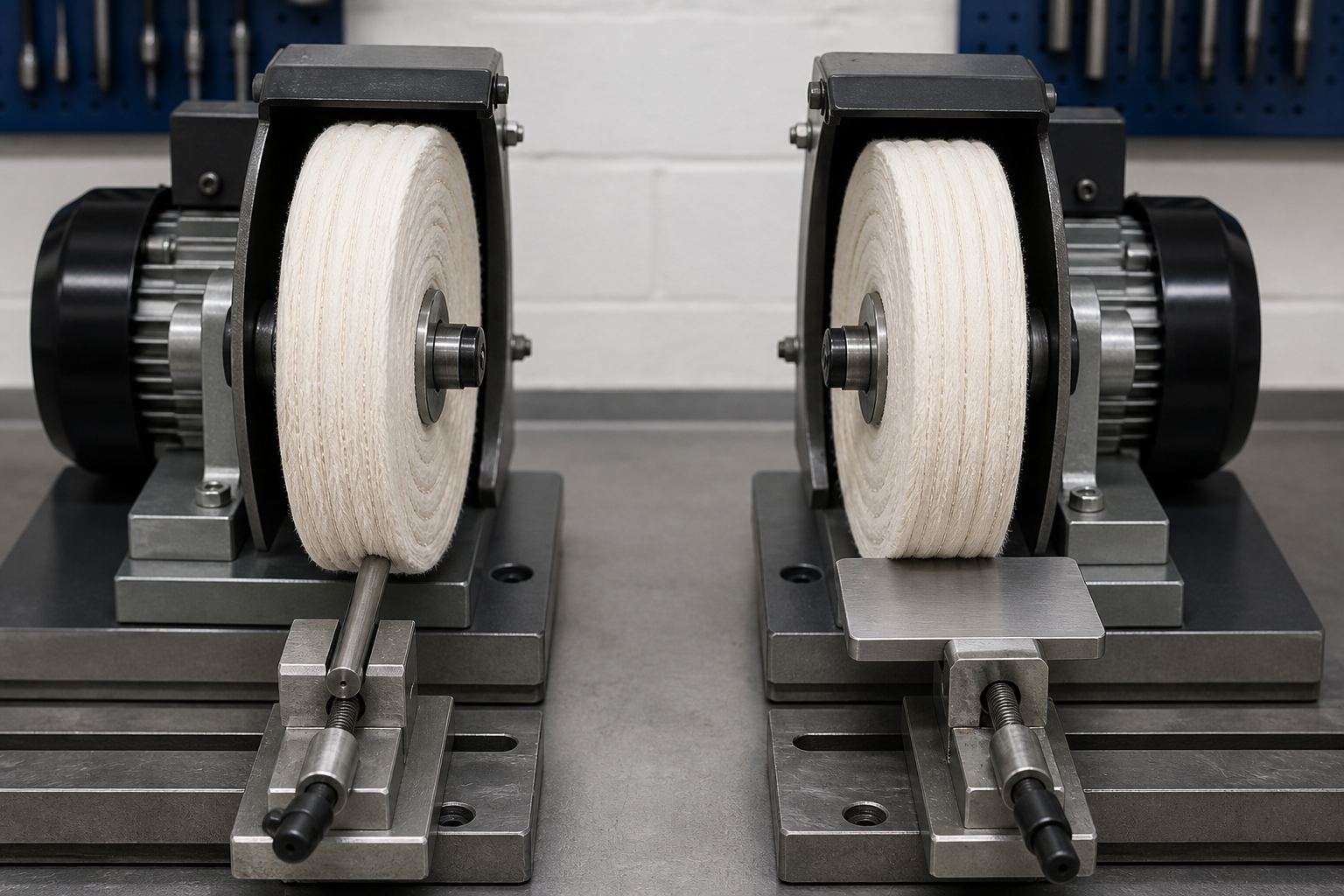
The larger the interaction area, the weaker the pressure transmitted to the surface from the force of the hand. This is why, on a large planar surface, the first polishing stage may work more weakly than on a small area of the same metal.
This is why planar items often require a more active first LUXI polishing stage.
Why contact area matters
Polishing does not happen across the entire visible surface at once. It happens in the contact zone between the item and the wheel. In this zone, local pressure, shear, heat, friction and interaction between LUXI compound and the metal surface layer occur.
On a small area, contact is concentrated. The wheel more easily creates the local pressure and shear needed to form the surface.
On a large plane, the same force of the hand is distributed over a much larger area. As a result, the local action becomes weaker. The surface may feel “stubborn”: the compound is applied correctly, the wheel is working, the operator is pressing as usual, but scratches and waves disappear more slowly.
This does not mean that a planar item should simply be pressed harder against the wheel. Trying to compensate for weak effect with pressure often leads to overheating, dirty work, geometry loss, excess compound and uncontrolled metal removal.
A simple pressure example
Take a simplified example.
The operator presses the item against the wheel with a force of about 5 kgf.
A small section of a ring shank:
2 × 4 mm = 8 mm²
Approximate pressure per unit area:
5 / 8 = 0.625 kgf/mm²
Now take a signet top:
5 × 7 mm = 35 mm²
Approximate pressure per unit area:
5 / 35 = 0.143 kgf/mm²
Ratio:
0.625 / 0.143 ≈ 4.4
At the same hand force, the pressure on the signet top is therefore about 4.4 times lower than on a small section of the shank.
This is a simplified model. In real polishing the wheel is soft, contact is uneven, there are micro-contacts, fabric elasticity, compound, heat and movement. But the practical conclusion remains: the larger the contact area, the lower the local pressure and the harder it is for the first polishing stage to form the surface.
A more visual example
If a small contact area is about 3 mm², and a large planar surface is about 80 mm², the difference becomes even clearer:
80 / 3 ≈ 26.7
At the same hand force, local pressure on the large plane may be about 26.7 times lower than on the small area.
This is why a small detail may quickly reach an even lustre, while a large surface of the same metal continues to show scratches, waves and preparation marks.
Why a plane shows defects more strongly
A large planar surface behaves like a mirror. It does not hide small errors; it emphasizes them.
On a plane, the following are clearly visible: scratches from abrasive preparation, waves from uneven removal, traces of wrong sanding direction, areas where the first polishing stage was not active enough, and micro-relief that would be less visible on a relief surface.
A plane therefore requires not just shine. It requires an even formed surface.
A finishing compound must not solve this task. If the plane has not yet been formed, finishing may temporarily add shine, but after washing or under different lighting the defects will reappear.
What “more active processing” means in the LUXI system
In the LUXI system, more active processing does not mean “press harder” and does not mean “apply more compound.”
Correctly strengthening the first polishing stage can be done through a more active first-stage compound, a more active wheel, a larger wheel diameter, more precise abrasive preparation or a smaller interaction area.
A more active first-stage compound
For first-group materials, the usual first-stage axis is:
LUXI Blue → LUXI Yellow → LUXI Gray → LUXI Black
If LUXI Blue works too softly for a large plane, a more active first-stage compound may be used.
This axis belongs specifically to the first polishing stage for first-group materials. It must not be automatically transferred to finishing compounds, and it must not be treated as a universal scale for all tasks.
A more active wheel
Sometimes the first polishing stage is strengthened not only by a more active compound, but also by a more active wheel.
Wheels have their own activity scale. In simplified form, from the softest to the most active:
white unstitched flannel → white unstitched muslin → white unstitched calico → white stitched muslin → white stitched calico → yellow stitched muslin → sisal wheel
In the LUXI system, unstitched wheels are usually used for finishing. But the full scale is useful for understanding the logic: wheel material, fabric density, stitching and stiffness change how the wheel interacts with the surface.
For the first polishing stage on large planar surfaces, more active stitched wheels are often more important, and in the most difficult cases, a sisal wheel. A more active wheel supports local shear better and helps the first polishing stage form the surface where the large contact area weakens the action of a usual compound-and-wheel pair.
For the most difficult production cases on first-group materials, the strongest configuration can be:
LUXI Black + sisal wheel
This is not a universal starting point. It is used only when the surface, material, plane size and preparation condition truly require such strengthening.
Increasing wheel diameter
Wheel activity depends not only on material, density and stitching, but also on diameter.
At the same rpm, a larger wheel has higher linear speed at the working surface. The larger the wheel diameter, the higher the speed in the contact zone, the more heat is generated and the more active the first polishing stage can become.
The difference between 4, 6 and 8 inch wheels is significant:
4 inches ≈ 102 mm — small wheel.
6 inches ≈ 152 mm — standard wheel.
8 inches ≈ 203 mm — large-diameter wheel.
At the same rpm, moving from 102 mm to 152 mm increases linear speed by about 50%, moving from 102 mm to 203 mm approximately doubles it, and moving from 152 mm to 203 mm increases it by about 33%.
The physics of this effect is explained in the article:
Wheel diameter, rpm and linear speed in the contact zone
More precise abrasive preparation
If a plane still has deep scratches, waves or marks from rough preparation, polishing will be forced to correct what should have been corrected earlier.
Sometimes the correct solution is not to make the compound stronger, but to return to surface preparation: correct geometry, remove rough marks, make preparation more consistent, move to a finer final abrasive stage and control the direction of abrasive scratches.
For especially difficult cases with pronounced near-surface defects, a cross-direction scheme is used. At the final sanding stage, the item surface is systematically prepared with 800 grit abrasive in one direction, forming parallel grooves — abrasive scratches from 800 grit.
Then the first LUXI polishing stage is performed at 90° to those grooves. This cross-direction logic helps activate the surface layer and strengthen the first polishing stage when a denser and more stable surface layer must be formed.
The detailed instruction is in the practical card:
Items with volumetric and hidden defects after casting, 3D prototypes and powder-based technologies
Reducing the interaction area
Sometimes the problem of a large plane can be solved not only by stronger compound, wheel or diameter, but by reducing the actual interaction area.
A narrower wheel, such as Razor Edge buff, can be used for this. A narrow working zone reduces the contact area, so the same hand force is concentrated on a smaller zone. This helps the first polishing stage work more actively and more controllably, especially on large planar or nearly planar surfaces.
The point is not to cut the surface, but to reduce the zone of simultaneous contact and better control surface formation.
Why not simply add more compound
When a large plane polishes slowly, the operator naturally wants to add more compound. In the LUXI system, this is often a mistake.
Excess compound creates a layer of old compound, removed metal and contamination between the wheel and the metal. The wheel loses direct, controlled contact with the surface. Instead of forming the surface layer, the process becomes dirtier and rougher.
How to tell that the first polishing stage is too weak
The first polishing stage should be strengthened or reconsidered if the large plane polishes noticeably worse than small areas of the same item, preparation scratches disappear too slowly, the surface remains wavy, lustre appears unevenly, the operator wants to compensate with pressure, compound has to be added constantly, the surface looks worse after washing, or the finishing compound is being asked to fix what the first polishing stage did not do.
In these cases, check the first polishing stage, not the finishing stage.
Practical selection logic
For a large planar surface, the thinking sequence should be:
- Check whether the surface has been prepared evenly enough.
- Check whether coarse scratches or waves remain.
- Make sure the wheel is clean and correctly prepared.
- Apply LUXI compound minimally.
- Evaluate whether the selected compound-and-wheel pair is active enough.
- Strengthen the first polishing stage if needed.
- Check whether the wheel type is active enough.
- Use a larger wheel diameter if needed.
- For large planes, consider a narrower wheel, including Razor Edge buff.
- Move to finishing only after the surface has been formed.
Apply in practice
- Large planar surfaces: strengthening the first polishing stage
- Surface preparation before LUXI
- Wheel preparation and minimal compound application
- Basic LUXI production route for first-group materials
- Difference between the first polishing stage and finishing
- Wheel diameter, rpm and linear speed in the contact zone
Mentioned products and tools
LUXI Blue
Basic first-stage polishing compound for first-group materials.
LUXI Yellow
More active first-stage polishing compound for first-group materials.
LUXI Gray
First-stage polishing compound for more demanding first-group tasks.
LUXI Black
The most active first-stage polishing compound for difficult first-group cases.
Sisal wheel
Active wheel for the most difficult first-stage polishing cases.
Razor Edge buff
Narrow wheel for reducing interaction area and making work on large planar surfaces more controllable.
Main takeaway
A large plane is harder to polish not because the metal is different, but because the hand force is distributed over a larger area.
At the same pressing force, local pressure and local shear are lower. A large plane therefore often needs a more active first LUXI polishing stage: a more active compound, a more active wheel, a larger wheel diameter, more precise preparation or a smaller interaction area through a narrow wheel.
The finishing stage must not correct the large plane. It should smooth and stabilize a surface that has already been correctly formed at the first polishing stage.