

 Integrated Polishing System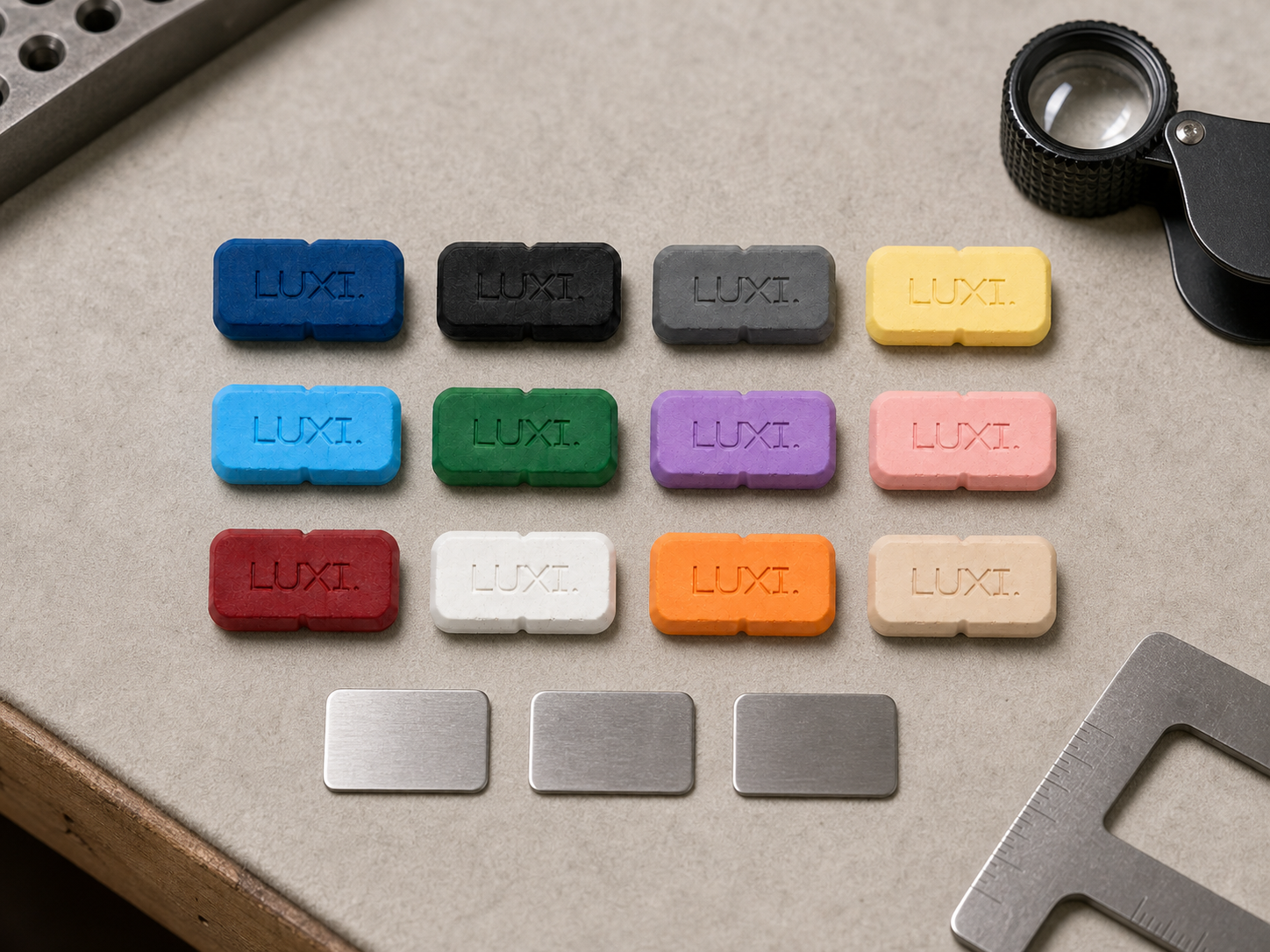
Use LUXI Sample Assortment to learn the LUXI system, compare justified compound candidates, and develop a repeatable process for the actual workshop. The assortment is not a mandatory sequence of every sample and does not prescribe one universal compound, wheel, speed, or workflow for all materials.
Define the task first
Before testing, record:
- material and surface condition;
- the assigned role: first stage, finishing, small-tool work, or another supported product-specific role;
- geometry, contact area, and features that must be preserved;
- available wheels and tools, their diameter, and working condition;
- known rpm and available speed control;
- the operation that follows polishing.
Complete repair, geometry, and appropriate abrasive preparation before the test. A polishing compound must not be asked to correct a deep scratch, crack, open cavity, unfinished shape, or skipped preparation stage.
Prepare a representative sample
Prefer a separate sample of the same material with the same preparation and comparable geometry. If no suitable sample exists, use a non-critical area only after assessing item risk. Do not transfer that result automatically to another material, size, geometry, coating, or construction.
Choose a reasonable candidate
Choose the first compound from current product-specific guidance for the material, surface condition, working tool, and assigned stage. Colour or maximum aggressiveness alone is not a selection rule. There is no need to test every sample in sequence.
If the starting recommendation does not give the required result, first check preparation, tool, diameter, rpm under load, pressure, contact duration, temperature, and compound loading. Only then choose a justified alternative for a separate comparison.
Change one variable at a time
Before every test, record:
- material and starting preparation;
- compound;
- wheel or tool and its diameter;
- rpm or actual speed;
- pressure;
- compound loading;
- contact duration and pass count;
- temperature or heat response;
- washing method and inspection conditions.
When comparing compounds, keep the other conditions the same. When comparing two suitable wheels, keep the compound and the other variables unchanged. If compound, tool, pressure, and duration all change together, the result cannot be assigned to one cause.
Run a short test
Use a separate clean wheel or tool for each compound, or a previously validated working-body cleaning or replacement procedure. Carrying old compound and removed material into the next test invalidates the comparison.
Apply compound minimally unless its product-specific guidance requires a different special procedure. Use short contacts, keep the item moving, control pressure and temperature, and allow the surface to cool.
Do not compensate for slow action with excess compound, excessive pressure, or prolonged continuous contact. If available wheels, tools, or speeds are limited, use the separate workflow “Developing a polishing route with limited wheels.”
Wash and inspect the result
After every test, move the item fully away from the working tool, allow the surface to cool, and completely wash away compound and removed material.
A compatible washing solution may be used. LUXI iClean is recommended as the most compatible option because it is designed around LUXI compound chemistry, supports gentler washing conditions, and helps preserve surface stability after polishing. Other compatible washing solutions may also be used. Ultrasonic washing, heated solution, and steam cleaning require whole-item eligibility.
Inspect under consistent directed light and record:
- repeatability;
- preservation of geometry, edges, and relief;
- remaining abrasive-preparation marks;
- surface uniformity and readiness for the next operation;
- contamination on open and difficult-access areas;
- overheating, colour change, haze, waviness, or smearing;
- condition of pores, cracks, cavities, coatings, inserts, and joints.
Accept or stop the test
Accept only a result that repeats after complete washing, cooling, and inspection, performs the assigned role, preserves geometry, and can be reproduced by another operator with the same equipment.
Stop if overheating, geometry loss, haze, smearing, cross-contamination, or surface instability increases. If testing reveals deep scratches, cracks, pores, cavities, or another defect outside polishing capability, do not intensify the process. Return the item to preparation, repair, or an assessment of suitability for further work.
Move to regular work
Document the accepted workflow so another operator can reproduce it. Scale only the required compounds, tools, and parameters validated by the test. Samples are intended for testing and process development; they are not full-size production packaging. This workflow makes no claim about current tub-product availability.