

Technology

Brush, Thread and Small Tool Logic

How brushes, cotton thread and small rotary tools change compound behaviour in reliefs, recesses and other low-temperature contact zones.

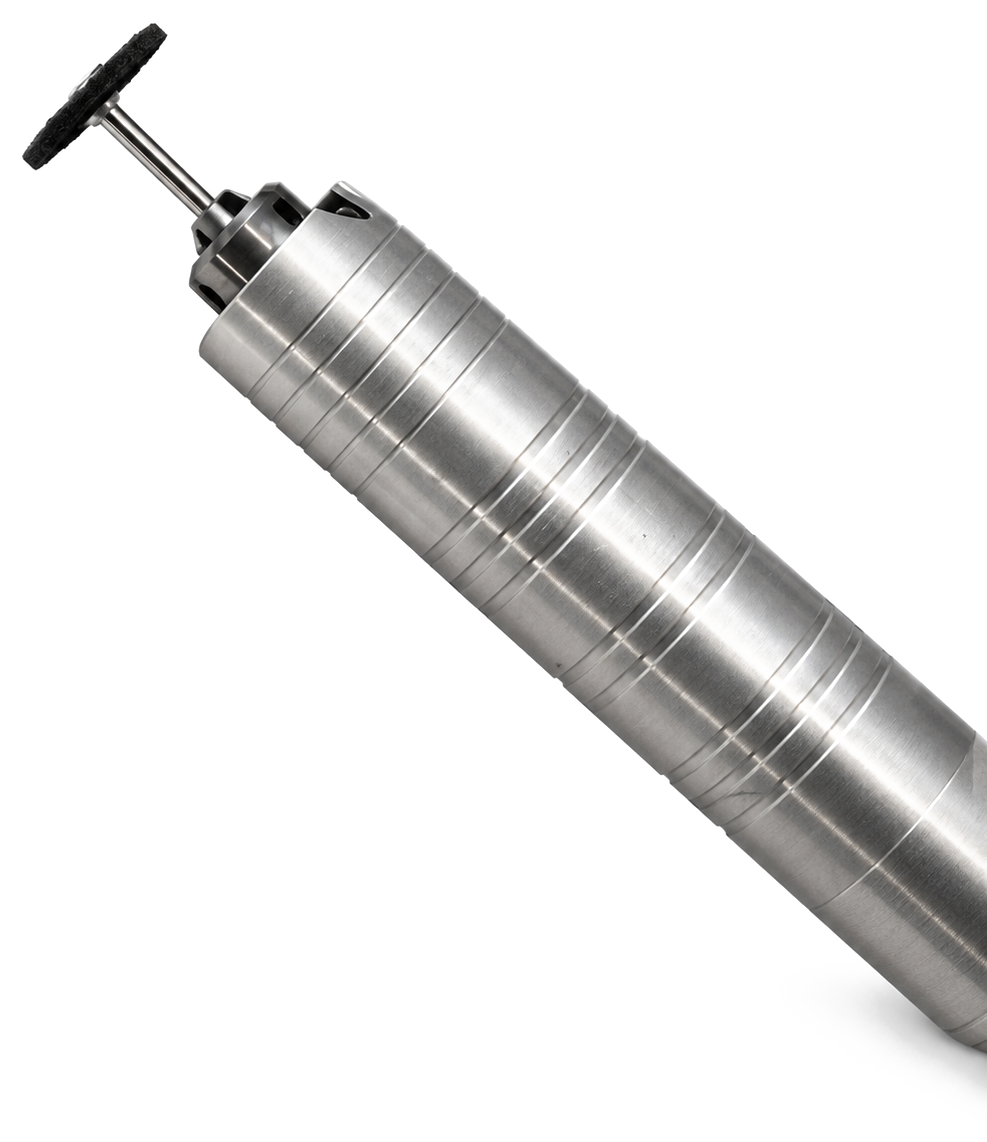
Rotary handpiece with small polishing disc

Why these tools need their own logic

A standard polishing wheel can reach many open surfaces, but it often cannot work cleanly inside relief, undercuts, narrow channels, stone seats, filigree, links and deep recesses. In these areas the process needs smaller carriers: bristle brushes, radial brushes, small mounted tools, cotton thread or cotton cord.

These tools are not simply smaller versions of a 6 inch polishing wheel. Their diameter, contact area, fibre stiffness and compound retention are different. The result is a cooler and weaker contact zone where the compound must stay on the carrier, transfer into the recess and still create useful polishing action.

Brush polishing is not standard wheel polishing

A brush touches the workpiece through many small bristle tips rather than through a broad continuous textile contact. The contact can be intermittent, directional and less stable. It can reach details that a wheel cannot reach, but the same compound may behave drier or less active because the brush produces less heat and lower effective pressure.

For this reason, brush polishing should be treated as a controlled access route. It is useful for recesses and details, but it still needs inspection, short passes and careful compound loading.

Low-temperature compound behaviour

Small tools can run at high rpm but still have low surface speed because their working diameter is small. Cotton thread and cord are even cooler because they create very little heat. In these conditions, compound mobility and adhesion become critical.

The key question is not only which compound cuts or shines on a normal wheel. The question is whether the compound can remain active when the carrier is small, cool and lightly loaded.

LUXI Purple: primary brush and thread route

LUXI Purple is the primary compound route for bristle brushes, cotton thread, cotton cord, relief, recesses and difficult-access polishing. Its role is not to replace every normal wheel operation, but to help the compound stay useful in cooler contact zones where a standard route can leave details dull.

Use it as a starting point for brush or thread access when the open areas polish acceptably but the recesses need a more suitable carrier and compound behaviour.

LUXI Green: more delicate controlled small-tool route

LUXI Green remains the more delicate low-temperature route. It is relevant when the user needs slower, more controlled polishing with small tools, light pressure and careful thermal control. This is especially important when the item, alloy, geometry or coating risk makes aggressive action undesirable.

In this layer, Green is reserved as a controlled small-tool path; exact working parameters depend on material, geometry and tool setup.

LUXI Asian Blue: short stiff brush in difficult recesses

LUXI Asian Blue is a special aggressive option for short stiff brush work in hard-to-reach recesses, local porosity smoothing and difficult areas where a normal wheel cannot act and a softer brush route is not enough.

This is not a universal brush recommendation. It is a controlled local route for cases where the required action is closer to aggressive smoothing than to final polishing. After this step, the surface should be inspected and brought back into an appropriate finishing route.

Cotton thread and cord polishing

Cotton thread or cord is useful under prongs, inside small openings, in narrow channels, between links and around detailed geometry. It gives access where even a small brush may be too wide or too uncontrolled.

The tradeoff is speed. Thread polishing is slow, cool and dependent on compound retention. It should be used deliberately for access and local correction, not as a replacement for all wheel or brush polishing.

Before plating and PVD

Recesses and relief should be inspected before plating, decorative coating or PVD. A surface that is dull before coating may remain visually weak after coating, and later correction can be risky because mechanical polishing may alter or remove the coating.

This layer therefore treats difficult-access polishing as a preparation question as well as a finishing question: if the recess must look bright after plating, it should be evaluated before the coating is applied.

Relation to the existing process layers

Brush, thread and small-tool logic sits after the wheel diameter / surface speed / temperature layer. It also connects to contact area and pressure, Wheel Logic and Workshop Capability Check.

The practical order is: confirm whether a normal wheel can reach the surface, identify whether the contact zone is small and cool, choose the carrier, select the compound role, test on a small area and keep the route separate from standard open-surface polishing until it is confirmed.