Technology

Second-Group Controlled Polishing Route

Controlled LUXI routes for hard, reactive and difficult materials where heat, pressure, wheel choice and preparation level matter more than hardness alone.

What do material groups mean?
Complete LUXI route for hard Group 2 metals

What belongs to second-group materials

second-group materials is not only a hardness category. In the LUXI system it describes materials where surface stability, heat, pressure, abrasive system and compound behaviour must be controlled more carefully than in ordinary first-group jewellery polishing.

Typical second-group cases include stainless steel, cobalt-chrome alloys, titanium, platinum, palladium, palladium white gold, zamak, pewter, zinc and tin alloys, hard or unusual alloys, and powder metallurgy or metal 3D printed parts when their surface behaviour is difficult to predict.

Hard second-group materials aggressive preparation

For titanium, stainless steel and cobalt-chrome, sanding may need to be followed by an aggressive preparation step before the first normal polishing stage. The purpose is to remove the deepest sanding marks, turn the sanded surface into a smoother matte surface, activate the surface and increase defectiveness of the microcrystalline surface layer so the next polishing stage can redistribute the Beilby layer in a more controlled way.

This stage is not final polishing. It is a readiness step that prepares a difficult surface for controlled polishing.

Standard hard second-group route

For stainless steel and Co–Cr, select the branch according to preparation and actual surface condition. LUXI Black, LUXI Gray and LUXI Yellow do not form a mandatory sequence. Platinum, titanium and soft metals use separate workflows.

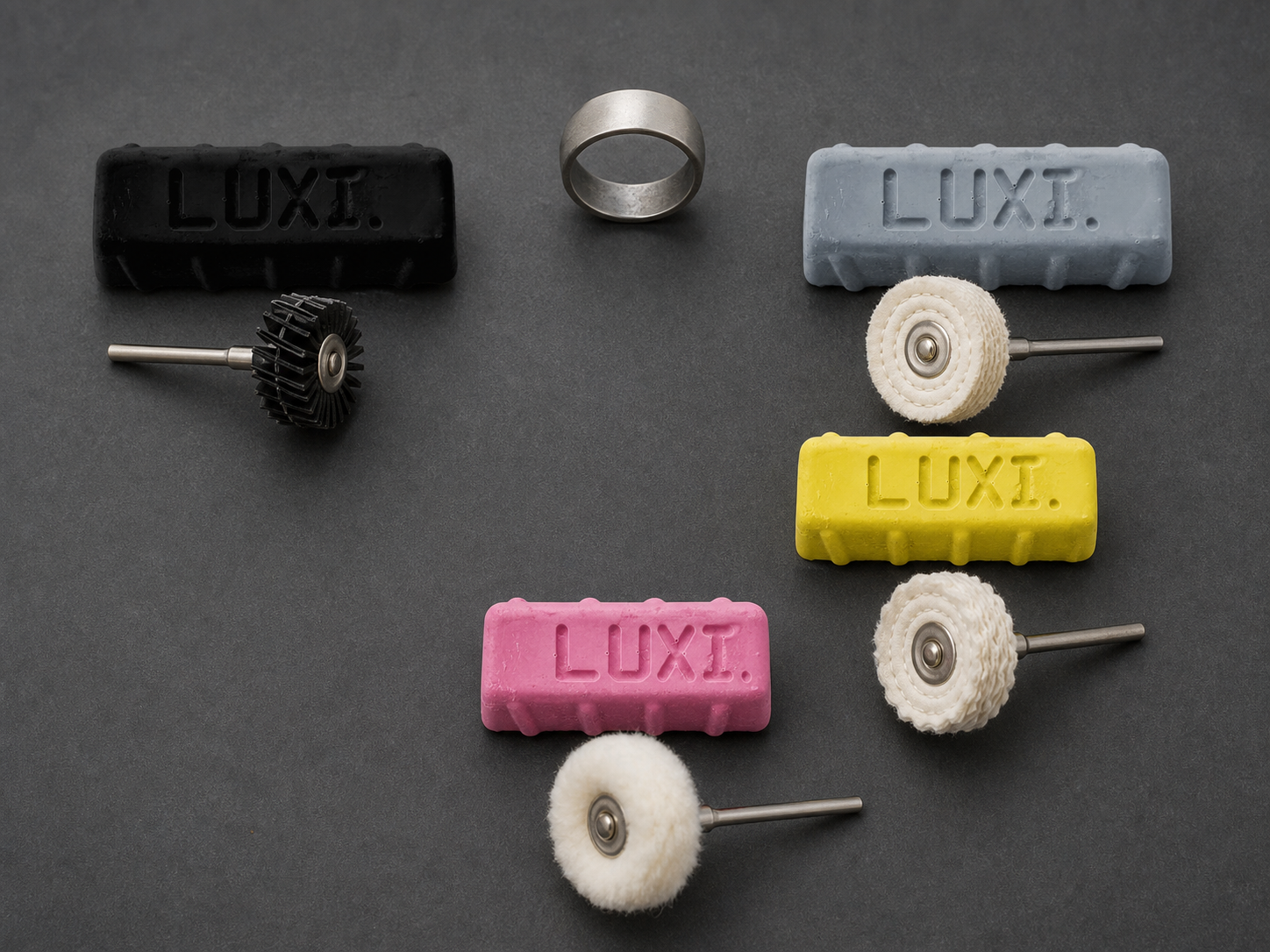
Use LUXI Gray as the first stage when its action is sufficient. Select its tool from the LUXI Gray product card; no universal fabric family is assigned. After complete removal of the entry marks, cleaning, cooling and inspection, move directly to LUXI Pink only if the surface is finish-ready.

Use LUXI Yellow only as an optional transition when the completed first stage needs a softer trace before finishing. Use a separate clean white stitched Calico wheel. LUXI Yellow must not compensate for an incomplete first stage.

Choose LUXI Black only when stronger first-stage action is needed. Select its tool from the LUXI Black product card; sisal is not mandatory for every item. After the completed LUXI Black stage, use optional LUXI Yellow only if needed before LUXI Pink. A separate LUXI Black → LUXI Gray transition is justified only when the necessary LUXI Black stage leaves a trace requiring LUXI Gray before finishing.

Stage 2 — final polishing: LUXI Pink + separate clean white unstitched Calico wheel.

For this hard second-group final stage, use a separate clean white unstitched Calico wheel, not muslin or flannel.

Asian Blue + Sisal as an extreme route

LUXI Asian Blue + Sisal buff is the most aggressive pair in the current LUXI system. Use it only as a special extreme route, readiness test, route for very large planar surfaces, very hard materials, or cases where LUXI Black + Sisal is clearly insufficient.

If LUXI Asian Blue on Sisal cannot turn a sanded surface into a reasonably smooth matte surface without visible sanding marks, the sanding preparation is probably insufficient for polishing. In normal practice, it is better to sand the piece to the level where LUXI Black + Sisal can work confidently, keeping Asian Blue + Sisal for special cases.

Stainless steel, cobalt-chrome and titanium

For stainless steel, choose LUXI Gray as the first stage when sufficient, or LUXI Black when stronger action is needed. Tools follow the respective product cards; LUXI Gray has no universal fabric assignment. LUXI Yellow on a separate clean white stitched Calico wheel is an optional transition after a completed first stage. LUXI Black, LUXI Gray and LUXI Yellow are not a mandatory sequence.

Co–Cr uses the same conditional branches, selected by the particular alloy, preparation and actual surface condition. The special LUXI Black → LUXI Gray transition is used only if the necessary LUXI Black stage leaves a trace requiring LUXI Gray. Move directly to LUXI Pink only when the preceding stage is complete and the cleaned, cooled surface is finish-ready; use LUXI Yellow only if a softer intermediate trace is needed. The final stage remains LUXI Pink + separate clean white unstitched Calico wheel.

Titanium is especially sensitive to overheating. Use short controlled contacts at all polishing stages, avoid continuous contact and do not compensate by long pressure. Overheating can create a loose surface, orange peel and uncontrolled surface-layer behaviour. Titanium may use the hard second-group route where aggressive preparation is needed, but the low-temperature Green route remains important for controlled finishing and small tools.

Platinum routes

Traditional platinum polishing often uses many sanding stages with small grit steps, sometimes reaching 1000, 2000 or 3000 grit, followed by multiple polishing compounds.

LUXI route A: if the surface is prepared to about 800-1000 grit, use LUXI Black, then LUXI Pink.

LUXI route B: if the surface is prepared to about 2000-3000 grit, use LUXI Gray, then LUXI Pink.

LUXI route C: use LUXI Green on a firmer stitched wheel, then LUXI Green on a softer unstitched wheel. On a firmer wheel, LUXI Green preserves aggressiveness longer. On a softer wheel, LUXI Green breaks down faster and moves toward finishing behaviour. This allows one compound to perform two process roles when the wheels are selected correctly.

Compound roles in the second-group layer

LUXI Pink is the high-mirror final compound for platinum, palladium, palladium white gold, stainless steel, pewter, zamak and cobalt-chrome after correct preparation. It can also give good shine on some first-group alloys, especially palladium white gold, but its strongest role is in second-group and difficult white or hard alloys.

LUXI Gray is the most delicate first-stage LUXI compound containing silicon carbide. For first-group materials, use Gray when LUXI Yellow is not aggressive enough, especially on large flat or open surfaces, but LUXI Black would be too aggressive or cause excessive metal loss. This is especially important for gold. first-group large-surface escalation is now: LUXI Blue -> LUXI Yellow -> LUXI Gray -> LUXI Black -> LUXI Black + Sisal.

LUXI Black has several roles: aggressive first-stage route for large flat first-group surfaces such as bronze, brass and silver when design allows; often too aggressive for gold if metal loss matters; first stage for platinum after 800-1000 grit; and aggressive preparation with Sisal for hard second-group materials. Black does not always mean Sisal. Wheel and material decide the route.

LUXI Brown is a clean Tripoli-style alternative. Traditional Tripoli is useful for zinc and tin alloys such as zamak and pewter, but may create silica or diatomite-based residue, dust and cleaning difficulty. Respirable silica dust is a known workshop hygiene risk where it is generated, so wording and process control should remain careful. LUXI Brown visually resembles Tripoli, but it does not follow Tripoli’s silica-based residue logic. It is designed to be cleaner and easier to wash, and it gives an excellent first stage on zamak, pewter, zinc and tin alloys. A practical route is LUXI Brown -> LUXI Pink after correct preparation.